Tengu stood out in Japanese folklore as a striking figure — part bird, part spirit, and often feared as a demon bird in older tales.
Over time, scholars and local communities reframed these figures. They showed how a creature could shift roles from menace to protector within a broader mythology and religious practice.
This introduction frames Tengu as one of the most recognizable beings in japanese mythology and explains why that change matters. It sets up an accessible guide that links myths, folklore, and faith without labeling myth as mere falsehood.
The article will trace early ominous tengu stories, later guardian portrayals, iconography, powers, moral lessons, and sacred places. It will also offer gentle cross-cultural comparisons to highlight shared themes across the world.
Readers will follow a clear arc showing how myth served to mark boundaries, teach values, and adapt as religion and local tradition reshaped a character like the Tengu.
Key Takeaways
- Tengu evolved from feared bird-demons to mountain guardians within Japanese belief.
- Scholars treat myth by function and cultural role, not by truth-status.
- The guide links early tales, iconography, and moral lessons for clear context.
- Cross-cultural notes show similar patterns in myths across the world.
- Readers will see how religion and local practice altered Tengu over time.
What “Mythology” Means and Why Tengu Stories Matter
Myths function as cultural scripts, not simple “false” tales, and they steer how people interpret danger, sacred places, and moral behavior.
Myth as sacred narrative, not “falsehood”
In folklore studies, a myth names a sacred narrative that carries meaning for a group. Scholars judge myths by function, not by literal truth.
How myths blend history, legend, and religion over time
Many communities mix myths, legend, and local history into a single story-world. A Tengu tale can hold older sacred layers and later local details side by side.
Why myth and ritual are often connected
Sacred stories often join ritual. Recital and enactment reinforce norms, authorize behavior, and make places feel protected or dangerous.
- Cultural memory: myths shape identity and warn people.
- Practical meaning: stories mark boundaries and safe routes.
- Respectful language: the article uses “myth” carefully when treating religious myths and belief.
Reading Tengu tales this way helps the reader see them as character-driven stories and as signals about what a community respects or fears.
Where Tengu Fit in Japanese Mythology and World Myth Traditions
Tengu occupy a flexible spot in Japan’s shared story-world, appearing in folktales, shrine lore, and popular media.
Mythology often works like a library of stories and characters that a culture revisits and reshapes. Tengu appear across regions and eras as a recurring type: sometimes dangerous, sometimes protective.
Myth as a cultural library
These tales collect explanations for natural events and social rules. A Tengu tale can warn mountain travelers or teach humility.
What comparative study reveals
Comparative mythology helps readers spot shared themes without claiming a single origin. It highlights motifs such as boundary-keeping spirits, mountain danger, tests, and punishment for arrogance.
- Recurring roles: guardians, tricksters, or teachers.
- Shared motifs: remote peaks, moral tests, and sudden events that change characters.
- Purpose: to show what stories do for a culture—mark danger, explain rituals, and reinforce norms.
Later comparisons to Greek myth will show familiar structures while honoring the distinct Japanese context of Tengu and their local resonance.
Early Roots of Tengu as a “Demon Bird” in Japanese Folklore
Ancient storytellers cast the Tengu as a fierce birdlike presence that marked certain mountains as perilous. Such imagery made a supernatural character memorable and easy to warn about.
How supernatural figures become central protagonists
In many myths, non-human beings step forward as main characters because their odd forms highlight danger and difference. A bird-demon shape instantly signals that this is not ordinary human business.
From ominous signs to cautionary tales in mountain settings
Natural events—sudden winds, lost trails, or strange cries—turned into story elements that reinforced caution. Communities used these tales to explain origin points for taboos and to mark places as outside normal times and rights.
- Early impression: frightening, winged imagery that sticks in memory.
- Narrative use: storms and storms-like events become plot devices.
- Form shifts: over times the Tengu keeps a core identity even as details change.
These early, scary stories set the stage for later reinterpretations. A threatening beginning helps explain why the same character could later be seen as a guardian of those very places.
How Tengu Evolved From Threatening Spirits to Mountain Guardians
Local belief and ritual reshaped the Tengu, shifting it from a feared presence to a guardian of paths and peaks.
Changing beliefs and shifting portrayals across time
Communities adapted old myths to match new religious practices and social needs. As clergy, travelers, and villagers retold tales, the Tengu gained roles that fit changing times.
From feared outsider to protector of sacred spaces
Rather than erase the old tale, people layered meaning. A once-dangerous spirit stayed the same in form but became a watcher who enforces boundaries and rewards respect.
Why mountains become a natural stage for transformation stories
Mountains are liminal places: remote, risky, and symbolically between worlds. They offer a clear way for stories to test characters and teach caution.
When a myth becomes a moral lesson
Over times, Tengu stories turned into short moral parables about humility and discipline. These stories mark what a culture values and guide behavior.
- Layering: older fear + new protection = richer tale.
- Function: myths teach norms and mark sacred ground.
- Continuity: the Tengu remains the same part of local history while meanings shift.
Types of Tengu and Their Most Recognizable Forms
Some Tengu look more avian, while others take on human features to teach or guard. This short guide lists major types so readers can spot recurring characters across art, shrines, and stories.
Karasu-tengu: the birdlike image
The Karasu-tengu emphasizes a winged, beaked body and often appears in early tales as a non-human threat. Visual cues—feathers, claws, a hooked beak—signal its airborne power and trickster behavior.
Yamabushi-style: humanlike guardian
The yamabushi-style tengu takes a more human shape and often wears ascetic garb. A human body and face make it fit the role of teacher, protector, or boundary-keeper in mountain shrines.
Polymorphic myths and coexistence
Scholars call this diversity polymorphic: multiple versions coexist because communities emphasize different needs. These types are not strict categories but helpful labels for tracking form and function.
- Practical list: Karasu (bird), Yamabushi (humanlike), hybrids (mixed traits).
- Why it matters: form often signals the tengu’s role in a tale.
- Note: types help readers follow patterns before iconography is examined next.
Iconography and Attributes Readers Should Know
A few repeated symbols keep the Tengu recognizable even when its role in a tale changes. This short visual language helps viewers read tone and intent before the full story unfolds.
Wings, beaks, and the demon-bird language
Feathers, hooked beaks, and wings signal otherness and danger at a glance. These traits act as visual shortcuts that mark a Tengu among other characters.
The long nose and symbolic meaning
The exaggerated nose often signals pride, heightened sense, or a sharp perception in mythic storytelling. It can turn a trickster into a moral signpost.
Fans, feathers, and mountain gear as badges
Fans, talismans, and ascetic robes are identity objects. They link the figure to wind, travel, and sacred peaks.
- Iconic markers help keep a myth familiar across time.
- Spotting certain traits gives a quick reading way—trickster, punisher, or guardian.
- These visual parts make myths stable in a changing culture.
Tengu Powers, Skills, and Supernatural Reputation
Storytellers assign the Tengu feats—like storm-wind and illusion—that turn ordinary events into moral trials.
Control of wind, storms, and sudden mountain danger
The Tengu often stirs sudden gusts or thick fog in mountain tales. These shifts make weather feel intentional, a signal that a boundary has been crossed.
Shapeshifting and illusion as classic tests
Shapeshifts and mirages test travelers’ judgment. In myths, such trials reveal pride or kindness in humans and set up a lesson.
Martial mastery and the training-of-humans motif
Some stories show the Tengu as a strict teacher in swordcraft and discipline. That role turns a fearsome being into a demanding mentor.
- Core traits: wind control, disguise, combat skill.
- Narrative use: abilities dramatize consequences and enforce limits.
- Function: tests guide behavior while keeping sacred places protected.
These abilities are not random. They serve the myth’s plot and prepare readers for the Tengu’s moral roles as teacher, trickster, or punisher in later sections.
Tengu as Moral Teachers, Tricksters, and Punishers
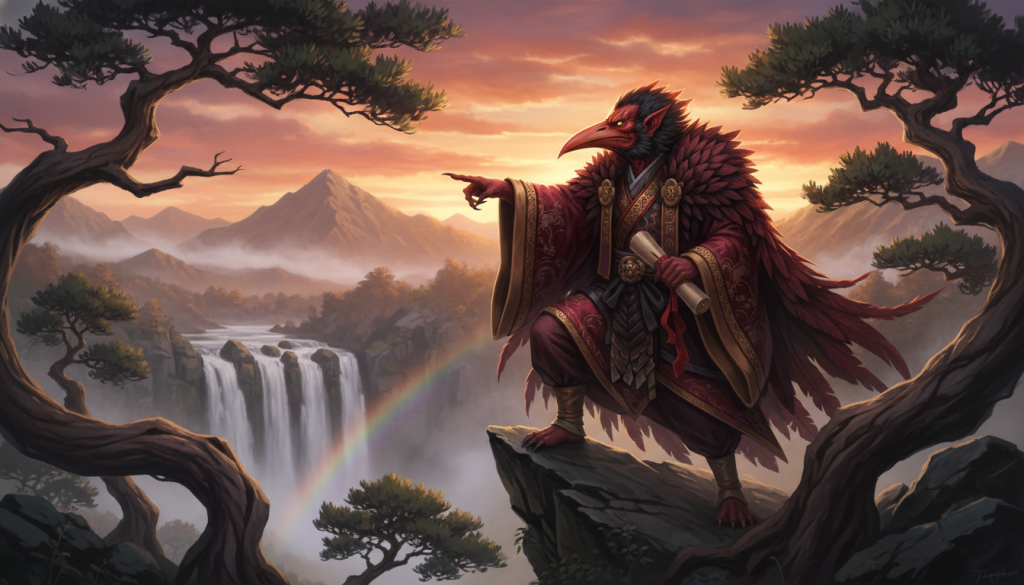
Tengu tales often set up moral puzzles where pride meets a swift, corrective force.
In many myths, a single story acts like a social test. A traveler who brags or disrespects a shrine usually pays a tailored price. That punishment teaches specific values—humility and respect—without a formal sermon.
Humility vs. arrogance as a recurring lesson
Across times, the same plot repeats: arrogance invites embarrassment or loss, while modesty earns guidance or escape. These episodes show what a community wants to protect—reputation, sacred ground, and social harmony.
How trickster behavior differs from outright evil
Trickster acts mislead, shame, or confuse to produce insight. A Tengu may hide a path or mimic a voice. That mischief is corrective, not purely malicious. It prompts reflection rather than simple fear.
- Function: myths confirm norms and teach patterns of behavior.
- Form: punishments often fit the offense—pride gets humbled.
- Role shift: as times change, characters tilt from predator to stern teacher.
Mountains, Sacred Places, and the Guardian Role
High ridges and hidden trails make excellent stages for stories that test humans against powers they cannot control. Mountains are physically remote and emotionally intense, so they suit sacred narratives that mark a shift from the everyday to the strange.
Why remote landscapes feel like thresholds
Peaks act as liminal zones in a myth world: travel uphill, and rules change. That change tells the reader a different moral frame is now in force.
Tengu as boundary-keepers
The Tengu often patrol ridges, forests, and hidden routes. They stand between the human world and spirit realms, enforcing respect and warning against arrogance.
Guarding forests, temples, and hidden paths
Guardians can be dangerous. Protecting sacred places often means stopping intruders. A stern boundary-keeper may punish trespass while still preserving a shrine or grove.
- Mountains mark a higher spiritual stake in many myths.
- Contrast: the sea offers wide openness; peaks demand proximity and test resolve.
- Across world traditions, gods and spirits defend temples, paths, and local order.
Read setting as a signal: deeper terrain usually points the story toward stricter rules and closer ties between place and power in a given culture.
Famous Tengu Legends and Story Patterns
Certain Tengu legends return again and again with the same moral engine: a test, a fall, and a chance to recover. These compact arcs make a tale easy to remember and pass on through oral tradition.
Common plot structures: temptation, punishment, and redemption
Many myths use temptation to reveal character. A proud traveler is tempted to boast, then faces punishment that humbles them.
Redemption often follows when humility or repair restores favor. That three-step arc keeps the lesson clear and satisfying.
How oral tradition preserves multiple local variants
Oral transmission creates variants rather than a single text. Villagers, monks, and performers adapt a story to local needs.
Different versions coexist; that variety is a strength, not an error. It shows how stories serve living communities.
What makes a tale feel like “myth” versus “legend”
A useful signal: a myth centers the supernatural and sacred, while a legend often highlights human actors in a near-past setting.
Readers should consult reliable sources and expect shifting details. Conflicting elements are part of how these myths and legends stay meaningful.
- Patterns: temptation → punishment → redemption.
- Variants: multiple local forms through oral sharing.
- Framing: myth vs. legend signals sacred cast and protagonist type.
Religion, Ritual, and the Sacred Dimension of Tengu Belief
Belief in Tengu can appear both as private devotion and as public ritual that structures behavior. In many communities, stories and rites work together so that storytelling gains force and ceremonies gain meaning.
How sacred narratives reinforce norms and values
Religious myths often offer models of conduct. A Tengu tale can warn travelers, praise humility, or justify a shrine rule. Those stories help people learn local values without a formal lecture.
Why calling a story “myth” can be culturally sensitive
In the United States, the word “myth” sometimes sounds dismissive. Scholars use “myth” descriptively to mean a sacred narrative, not to judge belief. That careful term helps protect respect for faith and custom.
- Stories and ritual support one another in daily practice.
- Authorities—both religious and civic—may endorse certain tales.
- Festivals, masks, and art keep these myths visible across generations.
Tengu in Art, Theater, and Japanese Cultural Memory
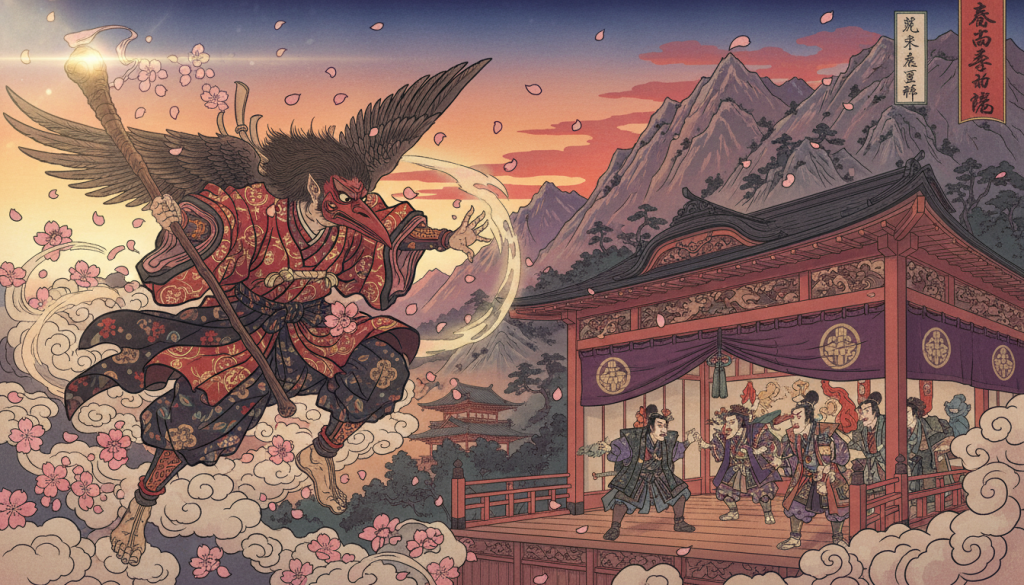
From painted screens to festival parades, Tengu iconography works like a shared archive that keeps the figure visible across time.
Mask imagery and visual memory
Tengu masks give viewers instant recognition. A long nose, vivid color, and stylized features act as reliable objects that signal a familiar myth.
These masks serve as a visual memory system. Even people who know the Tengu only from festivals can read the same cues.
Regional festivals to national symbolism
Local rites preserve variants while national festivals and art turn those forms into broader cultural signs.
Parades and theater keep certain marks consistent, so the Tengu remains part of public identity and shared values.
Performance, modern media, and cultural persistence
Theater and visual art paint the Tengu as funny, fearsome, or protective without losing core traits. That lets a single story adapt its tone while staying readable.
Modern anime and live-action series borrow mask design and stage cues. This reuse helps myths survive and reach global audiences.
- Iconic markers lock a figure into memory.
- Art and ritual act as a cultural archive.
- Local objects and performances feed national culture.
How Tengu Compare With Other Mythic Beings Across the World
Across continents, stories cast certain beings as guardians of edges—places where ordinary rules bend. The Tengu fits this pattern as a liminal figure who tests travelers, enforces respect, and marks sacred space.
Shared roles: guardians, monsters, and liminal spirits
Many cultures create spirits that guard thresholds. These figures act as protectors, punishers, or tutors. They appear where the human world touches danger or the sacred.
Greek parallels: gods, demigods, and sacred storytelling
In greek mythology, the greek pantheon organizes forces and offers moral models. Prometheus brings fire, suffers on a mountain, and illustrates punishment tied to sacred transgression.
Epic works like the Iliad and Odyssey preserve gods, heroes, and events such as the Trojan War. Those poems show how myth and literature overlap to teach values.
What cross-cultural comparison can and can’t prove
Similar motifs—sea boundaries, music as a supernatural tool, mountain punishment—reveal shared human concerns. They do not prove a single origin or direct borrowing.
- Useful: highlights common roles and lessons.
- Limit: cannot substitute for local context or sources.
Modern Tengu in Pop Culture, Anime, Games, and Fantasy
Contemporary media recast the Tengu into fresh roles, letting old symbols travel into new series and games. This process—called remythification—lets a single image keep meaning while gaining new story jobs.
Remythification: how old symbols get new meanings
Remythification means creators reuse familiar marks—long noses, fans, robes—so audiences read a quick signal. A game or an author may borrow those cues and reshape them into a teacher, a boss fight, or a quirky ally.
Why United States audiences keep discovering Tengu
Global distribution, translation, and fandom communities expose U.S. readers to these motifs. Franchise-driven series and author-led books, and even percy jackson–style popular works, prime readers to look for cross-cultural myth figures.
- Watch for depth: adaptations that keep guardian or teacher roles preserve complexity.
- Beware flattening: some versions reduce Tengu to “just a monster.”
- Value of remix: fresh stories keep the old myths alive in a new world.
How to Read Tengu Stories Like a Mythologist
To read Tengu stories with purpose, the reader looks for repeating parts that give a tale its shape. That approach treats each version as a clue about community priorities and social memory.
Spotting repeating theme units
Mythemes are the small, repeatable motifs—“boundary crossed,” “arrogance punished,” “illusion test”—that recur across variants. Tracking them shows what a story keeps and why.
Separate sacred function from entertainment
Ask what the tale does for people: warn travelers, uphold values, or justify a shrine rule. If a version exists mainly for thrills, it may be an entertainment retelling rather than a sacred practice.
Use sources responsibly and note reinterpretations
Prefer reputable translations, academic work, and reliable encyclopedias when tracing myths origin or history. Label modern riffs clearly as reinterpretations so readers know when a story shifts from sacred use to popular fiction.
Handle oral tradition and myth-versus-legend drift
Oral tradition produces multiple, local variants. Differences are meaningful choices, not errors. When supernatural actors get humanized, watch for myth legend drift and read the change as cultural adaptation.
- Practical way: compare versions, note repeating mythemes, and cite good sources.
- Final note: treat each tale as layered—history, sacred purpose, and storytelling may coexist.
Conclusion
Tengu narratives show how a people reshapes fear into guardianship: old birdlike threats become mountain watchers through retelling and ritual. This arc illustrates how myths persist by changing form to meet local needs.
The article restates key points: a clear definition of myth, the link between story and ritual, and the need for respectful language when treating sacred tales. Types, iconography, and powers work together to keep the Tengu recognizable across stories.
Readers should watch for core values—humility, boundaries, and respect for sacred places—and use cross-cultural parallels to illuminate themes without assuming direct borrowing. For further reading, consult reliable sources and compare variants, mythemes, and the shift from sacred function to modern entertainment in the wider world.