The Simurgh was a beloved creature in Persian tradition, often pictured as a phoenix-peacock hybrid that bridged sky and earth. This opening sets clear expectations for an easy-to-follow ultimate guide that explained its look, meaning, and role in ancient tales.
The article used the term mythology in the scholarly sense: a body of traditional narratives that mattered to a culture, not just a label for fanciful tales. Readers learned why whether a myth was literally true did not change its social importance.
The guide previewed the Simurgh’s recognizable form, its symbolic role in Persian myths, and why those stories helped people shape ideas about the world. It also noted why readers compared the Simurgh to similar creatures in other traditions.
Key Takeaways
- The Simurgh combined features of a phoenix and peacock and was central to Persian myth.
- Mythology here means meaningful traditional narratives, not just fictional stories.
- Readers will learn about the Simurgh’s appearance, symbolism, and cultural role.
- These myths shaped how people understood nature, fate, and society.
- The article compared Persian tradition with similar world myths to add context.
Why the Simurgh Still Mattered in Persian Mythic Storytelling
Storytellers gave the Simurgh duties that made it central to how a tale unfolded and what it taught. It did more than scare people. In Persian tales it appears as a guide, protector, and a test of character.
What made it more than “just a monster”
The Simurgh becomes a main character when it changes choices and outcomes. Readers spot a true mythic figure by its narrative job: it directs quests, heals, or reveals truth. That role separates it from hostile beasts that only block a hero.
How benevolence and guidance shaped its reputation
Its helpful acts reflect the culture’s values. The bird’s guidance shows a moral way and reinforces social ideals. It sits alongside gods and other supernatural beings without being reduced to a mere predator.
- Performs meaningful tasks in myths
- Shapes hero choices and the progress of a tale
- Often read as myth rather than simple legend
Mythology: What Myths Were and Why Societies Treated Them as Real
Myth here means a sacred narrative that shapes a group’s identity and behavior, not a simple falsehood. These stories often stage supernatural events and figures to teach how people should act in hard times.
Myths became socially binding when priests, elders, or rulers endorsed them. That official backing turned memorable tales into public truth. As a result, a community read mythic events as part of its shared past and moral map.
Stories repeat patterns of behavior. By retelling the same episode, a myth confirms values like courage, humility, or hospitality. Readers find models for choices and rituals in those brief, dramatic events.
- Myths function as sacred instruction rather than failed history.
- They merge with legend and recorded history in communal memory.
- Through repeated telling, they teach norms and social roles.
Understanding myth as function helps explain why the Simurgh’s tales mattered. They belong to a living framework that made remote pasts meaningful and guided real-world behavior.
Myth, Legend, and Folklore: Where the Simurgh Fit Best
One useful way to sort old tales is to ask whether gods or people lead the action. That test helps place the Simurgh without forcing it into a single label.
How scholars draw the line
Myths usually center on supernatural characters and remote, sacred time. Legends more often focus on humans and plausible events set in a recognizable past.
Folklore covers everyday customs and short tales that communities pass along. Over time, the same stories told across generations can drift between these categories.
Why truth mattered less than role
Communities often treated these narratives as part of their history, but scholars look at what the story does. Function—teaching values or explaining the world—matters more than factual proof.
The Simurgh is a clear example: as a legendary creature it plays a mythic role even when humans are central to a tale. Readers can describe its place by noting its function in different stories rather than forcing a single genre label.
- Myths: gods and cosmic settings
- Legends: humans and local history
- Folklore: everyday tales and customs
Persian Mythology in the Wider World of Myth Traditions
Comparative studies place Persian stories side by side with other traditions to highlight both echoes and differences. This approach treats a people’s myths as a set of symbolic patterns and a field of study. It helps readers spot recurring themes across the world while respecting local meanings.
How mythologies were categorized across regions and cultures
Reference works and encyclopedias often sort mythologies by region, language, or historical empire. That makes it easy to find a list of tales or primary sources for a given culture.
- Regional grouping—like Near East or Mediterranean—frames comparative questions.
- Language and scripture help scholars trace how stories moved between peoples.
- Catalogs and category pages make myths accessible to modern readers.
What “Persian” signaled in comparative terms
“Persian” marks a cultural tradition with its own symbols. It is not simply a local version of greek mythology, though readers in the United States often know Greek narratives and greek gods best.
Comparative mythology then becomes a tool. It highlights parallels without claiming a single source for all similarities. That clarifies how creatures like the Simurgh belong to Persian thought while also resonating with wider world patterns.
The Simurgh at a Glance: The Phoenix-Peacock Hybrid People Remembered
A quick visual sketch helps readers spot the Simurgh in art and stories at a glance. This short view names the main traits and explains why those cues matter when tales move fast or are told aloud.
Visual identity, body traits, and symbolic form
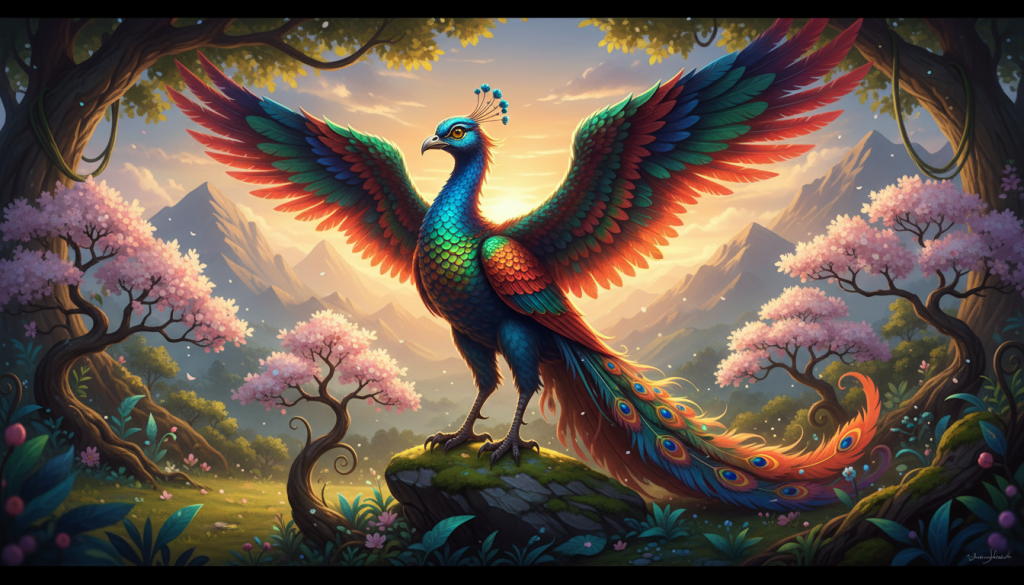
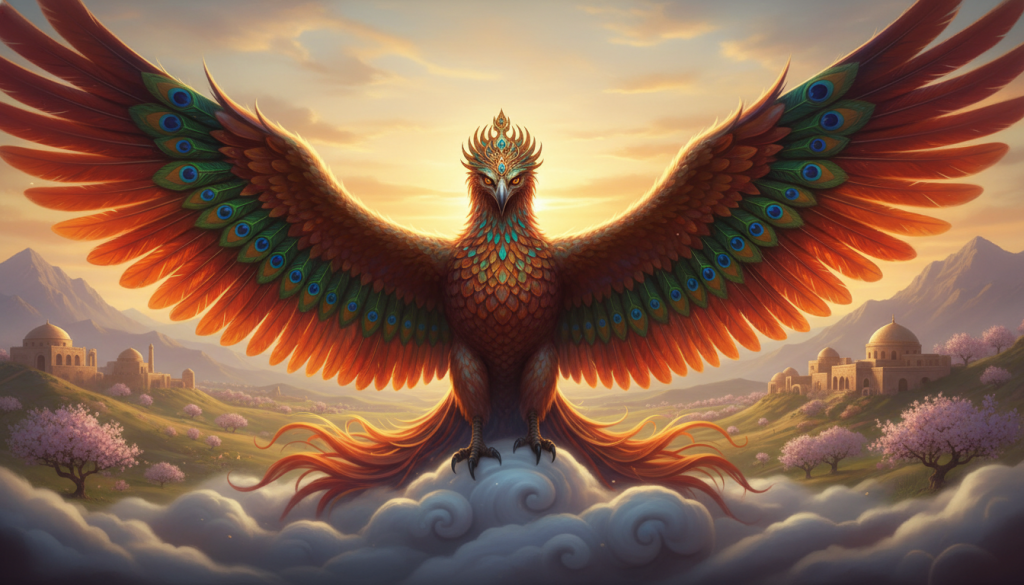
The Simurgh’s body is typically birdlike: a broad chest, long wings, and a sweeping tail that echoes a peacock’s plumage. These features signal grandeur without threatening force.
Its overall form blends phoenix heat and peacock color so the creature reads as both reborn and regal. Artists used contrast—fiery head, iridescent tail—to cue a viewer to its special role in a myth.
- Recognizable bird anatomy that suggests flight and care, not just power.
- Hybrid form that combines multiple symbolic meanings into one image.
- Visual cues that let people identify the figure quickly in oral stories.
Hybrid creatures like the Simurgh act as meaning-composites. The look helps an audience read the being’s role at a glance and so guides the way a tale unfolds.
Origins and Early Context: How the Simurgh Entered Persian Stories
Many origin tales place the Simurgh in a vast, undefined age when the world was still taking shape. This primordial setting makes the creature part of the creation story and links it to how early order emerged.
Primordial times function as a stage where institutions, taboos, and key social rules first appear. By setting events in these remote times, storytellers made customs feel rooted and sacred rather than accidental.
The myths origin framework explains why the Simurgh often shows up at turning points. It helps readers see the bird as a force that legitimized rites, advised rulers, or marked moral boundaries for a community and its history.
Origin tales do not need modern proof to be culturally real. Their job is to frame what a society treats as foundational and to provide meaning for later events.
- Primordial times set the scene for origin and creation.
- Origin stories explain institutions and social taboos.
- The Simurgh appears as part of a narrative logic that shapes culture.
Meaning and Symbolism: What the Simurgh Represented
The Simurgh functions as a compact symbol that holds several cultural lessons at once. It is not just a character trait; it is a narrative tool that teaches and shapes outcomes in stories.
Goodness as a narrative function
The bird’s helpful acts signal an ethical pattern, not a fixed personality. In many myths the Simurgh appears to test or guide heroes and to reward moral action.
Spiritual growth and transformation
Its rise and flight stand for change. Readers see inner growth through images of elevation, renewal, and rebirth, which make abstract moral lessons visible.
Nature imagery and transcendence
Bird, sky, and feather imagery point to freedom and insight. These natural cues let storytellers talk about higher meaning without complex argument.
Community needs and shared ideals
As a guardian figure the Simurgh compresses social values into a single memorable image. That makes it easy for a culture to pass lessons along through myths.
- Symbolism ties meaning to action in the tale.
- Images help audiences recall and retell lessons.
- The Simurgh carries layered meanings across time and world contexts.
What the Simurgh Did in Stories: Roles, Powers, and Narrative Jobs
In many accounts the Simurgh steps into a crisis to alter a hero’s path with counsel or healing. It rarely dominates a scene by force. Instead it offers timely aid that makes new outcomes possible.
Protector, guide, and healer archetypes
The bird acts as a protector by sheltering heroes from harm. It serves as a guide by giving wisdom and pointing a better way. It heals wounds, literally or through knowledge that restores a hero’s strength.
Helper figure in hero journeys and trials
Helper figures change what a hero can attempt without removing risk. The Simurgh gives support while leaving the choice and effort to the heroes. That partnership highlights bravery and moral action in the story.
- Appears at turning points to shift possibilities.
- Assists characters without solving every problem.
- Functions as a narrative device that embodies meaning more than a list of powers.
As a result, the Simurgh’s role ties to a larger pattern in myths: heroes succeed through relationships, wisdom, and sacred support rather than by lone combat. Its “powers” work as story mechanics that teach resilience and shared values.
Mythic Characters and Creatures: Reading the Simurgh as a Prosopomyth
Some figures in old stories become so central that they feel like a living idea rather than just a plot device. Cultural critics call that a prosopomyth: a character who turns into a myth in people’s minds.
Why gods weren’t the only main players
Not every main role in a story belongs to a god. Many myths give center stage to divine beings, demigods, or other supernatural figures. At the same time, legendary animals and helpful spirits lead plots and teach lessons.
Legendary creature vs divine figure: a practical classification
The Simurgh functions better as a legendary creature than a full god. It carries sacred weight and guides heroes, yet it does not command worship like a god. Treating it this way helps readers see how the bird shapes outcomes without confusing it with deity status.
- Prosopomyth: a figure that becomes a standing symbol in tales.
- It complements gods and godlike beings without replacing them.
- Humans in these stories remain agents, but the Simurgh raises the stakes by acting on a supernatural register.
Myth and Ritual: How Sacred Narratives Supported Cultures
Recital and ritual combine when narratives become scripts for communal behavior. Stories move from telling into doing when a group repeats words, gestures, or rites tied to a shared past.
The link between reciting tales and enacting rites
Speech often cues action. In many societies, a myth ritual functions as both story and instruction: reciting a scene can call for a matching rite that restores balance or marks a change.
How sacred stories established sanctity and order
Religious myths helped make places and roles feel official. By naming who belonged where and why, these tales reinforced institutions and set expectations for behavior.
The Simurgh’s stories could sit at the edge of ritual life. When people retold its deeds during public events, they often affirmed what was protected or sanctioned in their culture.
- Myth ritual links words to communal acts that bind people together.
- Recitation of religious myths confirms values and the purpose of rites.
- Stories lend social and psychological power to rituals, not only supernatural force.
Scholars read these links in different ways, but the practical result is clear: myths and rituals work together to shape how communities treat important events and who they trust to guide them.
How Scholars Interpreted Myths: Approaches Readers Used to Understand the Simurgh
Interpreting the Simurgh asks readers to balance image, function, and cultural context. Scholars do not rely on one lens. They combine textual study, social history, and psychology to get a fuller view.
Symbolic readings ask what images mean. They track motifs, colors, and gestures to read spiritual messages embedded in a tale.
Functional readings ask what stories do. These readings show how myths shaped behavior, authority, and community choices.
Myth criticism as an interdisciplinary toolkit
Myth criticism borrows methods from literature, anthropology, and psychology. That toolkit helps readers avoid turning a creature into mere fantasy. It shows how an author or storyteller adapts older sources and social needs.
Cultural Myth Criticism and modern challenges
José Manuel Losada’s Cultural Myth Criticism urges reading a myth from inside its sacred horizon. It warns that globalization, relativism, and immanence can reduce living myths to decoration.
- Use clear sources to tell author changes from cultural meaning.
- Compare carefully; similarity need not mean shared origin.
- Let both symbol and function guide interpretation.
Comparative Mythology: Simurgh Parallels Readers Noticed Across Cultures
Comparing the Simurgh’s role with well-known Greek episodes helps readers see common storytelling moves without implying copying.
Prometheus and the gift of fire
Prometheus stole fire from Hephaestus’ workshop and gave it to humans. Zeus punished him, chaining him while an eagle ate his liver until Heracles freed him. This story makes fire a civilizational gift and shows the cost of defying the gods.
The Moirae and fate as a tangible image
The three goddesses—Clotho, Lachesis, and Atropos—turn fate into action by spinning, measuring, and cutting a thread. That image makes destiny feel concrete in a way similar to how the Simurgh makes guidance visible in Persian tales.
Chaos to Olympians: creation and order
Hesiod’s Theogony moves from Chaos to Uranus, the Titans, and then Zeus’ rule. That arc frames creation and the rise of an ordered world. It echoes a common pattern: stories that explain how order replaces primeval disorder.
- These examples come from greek mythology but do not prove direct borrowing.
- Shared human concerns—gifts, fate, and order—produce similar story tools.
- The Simurgh remains rooted in Persian meaning while matching broader narrative functions.
Sources and Story Transmission: How Myths Were Preserved Over Time
Many tales survived because people kept telling them aloud long before ink set the words on paper. Oral tradition formed the first layer of preservation. Performers, elders, and traveling storytellers held stories in memory and shaped them by retelling.
Oral tradition, epic poem culture, and retellings
Epic poem culture then anchored speech into longer works. Famous epics like the Iliad and the Odyssey, set around the Trojan War, collected threads of older oral tales into readable poem form.
Those epics made a durable backbone that later authors and series echo. Modern retellings borrow structure, motifs, and character arcs even when they change tone or detail.
How the field grew: collection and study
Over time, mythology came to mean both the collection of stories and the academic study of them. Scholars gather texts, compare versions, and trace how oral tradition fed written works.
- Oral tradition kept plots flexible and alive.
- Epic poem texts like the Iliad and the Odyssey fixed core scenes from the Trojan War tradition.
- Ongoing retellings turn ancient myths into new series for modern audiences.
For Persian storytelling, the Simurgh lived in that same ecosystem: remembered by voice, shaped by poets, and revived by later authors for new readers.
The Simurgh in Modern Culture: How Ancient Myth Lived On
Contemporary worldbuilding often repurposes classical myth images to give stories moral weight and emotional clarity. Writers reuse mentor figures, sacred helpers, and symbolic animals to guide plots and reveal a hero’s growth.
Mythic motifs appear in many popular works. For US readers, the Percy Jackson books are a common gateway. That series made quests, gods, and quest objects easy to find for younger readers.
How motifs drive interest
Readers search for “mythology stories” and creatures because they want clear, character-driven explanations. Quest hooks like the Golden Fleece or the Jason and the Argonauts arc send new audiences to related myths.
Respectful reuse in worldbuilding
- Use the Simurgh as a guiding presence, not a generic phoenix reskin.
- Keep its benevolent guidance as a defining trait.
- Acknowledge cultural roots when adapting motifs for a modern series.
Well-done adaptations invite readers from Greek mythology and beyond to explore Persian myths. Pop culture can spark curiosity so audiences follow one story into many rich myth worlds.
Conclusion
In sum, the Simurgh is best read as a benevolent guide whose meaning comes from its acts in myth and tales. It proves that a creature’s role in a story matters more than a label or divine rank.
Readers should use three tools: spot whether a tale behaves like a myth or a local legend, read images as symbolic cues, and apply careful comparative insight without erasing Persian specificity.
Myths speak to humans and communal life as much as to gods; they shape ritual, values, and memory. Motifs—from sea-crossing quests to fertility images—also surface in music and modern storytelling, where meaning shifts but the echo remains.
Why it matters for a US reader: exploring non-Greek traditions expands the map of mythology and deepens how people see cultural values. Follow this thread into more Persian stories to learn how communities made meaning in the past.