The bunyip is a key part of Australian myths. It’s said to live in swamps and waterways in southeastern Australia. Many Aboriginal groups tell stories about it. The name bunyip might come from the Wemba-Wemba or Wergaia languages of Victoria.
Early reports, like one in the Sydney Gazette in 1812, made the bunyip famous. Scholars say bunyip tales have many uses. They warn of dangers near water and show the deep connection of Indigenous cultures.
Stories of the bunyip vary by region. For example, the Ngarrindjeri talk about Mulyawonk, a water spirit that keeps rivers healthy. Over time, European settlers and writers mixed real stories with myths and fossils. Now, the bunyip is known in children’s books and Australian culture, linking old myths to today’s curiosity.
Key Takeaways
- The bunyip is a central figure in Australian mythology linked to swamps and waterways.
- Its name likely originates from Wemba-Wemba or Wergaia languages of Victoria.
- Bunyip stories function as cautionary tales and reflect long Indigenous cultural continuity.
- Regional variations include the Ngarrindjeri Mulyawonk, a protective water spirit.
- European contact and fossil discoveries shaped modern perceptions of the bunyip.
- The bunyip remains part of mythology history and popular culture in Australia.
Introduction to Bunyips
The bunyip is a creature from Australian stories. It lives in water at night. People say it’s found in lakes, rivers, and swamps.
How people describe the bunyip changes depending on where they are. Some say it has fins and flippers. Others talk about a long neck and small head. This shows how stories can change over time and place.
What Are Bunyips?
Bunyips are said to be shy and live in water. They make loud noises at night. Some think they look like seals or starfish.
They eat crayfish and can be dangerous near water. Some stories say they lay eggs in platypus nests. This connects them to real-life wetland animals.
The Role of Bunyips in Indigenous Culture
In Aboriginal stories, bunyips teach important lessons. Elders use these tales to warn kids about water dangers. They teach respect for nature and caution near water.
These stories also show how different cultures meet. European settlers heard about bunyips and wrote about them. This helped spread the legend and kept important lessons alive.
The Origins of the Bunyip Legend
The bunyip legend comes from ancient stories and 19th-century reports. Aboriginal peoples have long told tales of water spirits. These stories were recorded by European settlers and shared in newspapers and museums.
Historical Accounts and Sightings
The first mention of the bunyip was in 1812 in the Sydney Gazette. In the 1840s and 1850s, many people in Victoria, New South Wales, and South Australia claimed to have seen it. Newspapers like the Geelong Advertiser linked fossil finds to bunyip stories in 1845.
Sketches from eyewitnesses were published in accounts from the Murray and Goulburn rivers. William Buckley wrote about seeing amphibious creatures near Lake Modewarre. In 1846–47, a skull found by the Murrumbidgee River was shown at the Australian Museum.
Later, it was identified as a deformed foetal skull of a foal or calf. Edwin Stocqueler’s reports and sketches helped shape the public’s idea of the bunyip.
Cultural Significance in Aboriginal Mythology
Aboriginal stories saw the bunyip as more than a monster. They were warnings about using resources wisely and staying safe near water. For the Ngarrindjeri, Mulyawonk stories taught about sharing fish and caring for the land.
Mythology studies show these stories as guides for morality and the environment. They link people to their surroundings and rules. Scholars see the bunyip as part of a larger set of ancient myths.
Looking at sightings and written records alongside Indigenous stories gives a clearer picture. This mix of European curiosity and Aboriginal knowledge shapes the bunyip’s place in local lore and broader mythology studies.
Physical Characteristics of Bunyips
The looks of bunyips vary by location. People describe them in many ways, influenced by their surroundings and fears. These stories add to the myths of wetlands and rivers.
Common Descriptions Across Regions
Many reports share similar traits. One common image is a “seal-dog” about four to six feet long. It has a shaggy coat, a round head, whiskers, and big ears. This description is seen in about sixty percent of old stories.
Another common sight is a long-necked creature, five to fifteen feet long. It has a maned neck and a head like a horse or emu. Some say it has small tusks, big ears, and a horse-like tail. About one-fifth of stories describe it this way.
Some people see emu-bill shapes, alligator-like bodies, or even starfish-like forms. They also hear loud roaring calls and see it swim fast with flippers. These traits connect bunyips to ancient water and danger symbols.
Variations in Size and Appearance
Size estimates vary a lot. Some say they are small, like dogs. Others claim they are as big as serpents or alligators, stretching yards. This makes it hard to define a single look for these creatures.
Experts think there are several reasons for these differences. Maybe people mistake seals, birds, or remember extinct animals. Also, stories from each area reflect local fears and landscapes.
Looking at these descriptions, we see how stories and eyewitness accounts blend. They weave a rich mythology around Australia’s water creatures.
Bunyips in Literature and Art
The bunyip has moved from riverside whispers into books, halls, and public squares. Its presence in early colonial writing and museum displays helped shape how Australians and visitors imagined the creature. Artists, playwrights, and illustrators kept the image alive, turning oral mythology stories into printed tales and visual works.
Early written accounts
19th-century reports fed public curiosity. William Buckley’s 1852 recollections and an 1899 Journal of the Anthropological Institute tale later reprinted in Andrew Lang’s The Brown Fairy Book (1904) show how colonial writers recorded encounters. Newspapers and museum exhibits, such as the Sydney display of a skull in 1847, gave the bunyip formal attention. Sketches by illustrators like Edwin Stocqueler reached wide audiences. These records tied oral myth to printed mythology history.
Modern representations in media
In the 20th century, the bunyip grew into children’s literature and stage works. Colin Thiele’s Gloop The Gloomy Bunyip (1962) and Michael Salmon’s Alexander Bunyip (1972) reshaped the creature for young readers. Jenny Wagner’s The Bunyip of Berkeley’s Creek (1973) added another playful voice. Film appearances and songs such as “Bunyip Moon” expanded reach. Public art and statues, including the Alexander Bunyip statue in Canberra, turned mythological creatures into tourist-friendly icons.
Writers and artists continue to use mythological symbols from Aboriginal lore and colonial storytelling. The bunyip functions as a link between living traditions and popular culture. Museums, children’s publishers, and local councils preserve and reinterpret these images for new audiences.
Exploring Bunyip Habitats
The bunyip legend grew from the wetlands in southeastern Australia. These stories linked the creatures to billabongs, swamps, creeks, and riverbeds. Aboriginal warnings kept people away from these places, blending safety with myth.
Swamps and waterways
Wetlands provided cover and sounds that sparked tales of mythological creatures. The Murray and Darling Rivers were hotspots for sightings. Deep pools and reed beds hid wildlife, making it hard to tell what was real.
Factors leading to sightings
- Settlers were new to Australian animals, mistaking platypus and others for unknown beasts.
- Animals moving with the seasons made water sources busier, leading to more sightings.
- Seals traveling inland surprised people, adding to the mystery.
- Poor night vision and strange bird calls made sounds seem spooky.
- Stories of extinct animals and traditions shaped how people saw rare sightings.
The environment, social context, and long storytelling traditions fueled bunyip tales. These factors made wetlands seem full of myth and kept the legend alive for generations.
Scientific Investigations of Bunyips
Scientists have studied bunyip sightings for a long time. They use tools from natural history and folklore. This review looks at physical specimens, fossil interpretations, and eyewitness testimony. It shows how legends and evidence interact in mythology studies and history.
Early scientists looked at unusual skulls and bones. In 1847, a so-called bunyip skull was examined. It was found to be a deformed foetal skull of a foal or calf. This discovery sparked public interest and fueled stories of strange animals.
Charles Fenner suggested in 1933 that inland seals might explain some reports. He mentioned southern elephant seals or leopard seals moving up rivers. These seals have smooth fur, large eyes, and loud calls.
Other researchers linked some accounts to fossil finds. Paleontologists Pat Vickers-Rich and Neil Archbold noted that memories of extinct megafauna might be behind some traditions. These fossil interpretations connect tangible remains with oral histories, a crossover relevant to mythology history and to scholars studying mythological beings.
The Debate Among Researchers
Today, most scientists see the bunyip as folklore. They have not found a living species that matches the descriptions. Theories range from misidentified seals and birds to cultural memory of megafauna or symbolic cautionary tales.
- Some naturalists stress comparison with known animals and the effects of decomposition on appearance.
- Folklorists emphasize oral transmission, noting how stories adapt over generations.
- Researchers in mythology studies examine how mythological creatures reflect environment and social norms.
Recent work shows that Indigenous oral histories can preserve ecological events over long spans. This evidence supports careful study of legend and memory. Debates persist among paleontology, biology, and folklore communities about how to weigh each line of evidence.
The conversation about bunyips sits at the intersection of field observations, museum specimens, and comparative mythology. The exchange among disciplines keeps the topic active in mythology studies. It invites further scrutiny of claims about mythological creatures and beings.
Bunyip vs. Other Cryptids
The bunyip is a water-dwelling mystery from around the world. It comes from Aboriginal stories, giving it a unique flavor. By comparing it to famous cryptids, we see common themes and its special origins.
Comparing traits
The Loch Ness Monster is known for its long neck and elusive nature. Some bunyip stories also mention long-necked creatures. Both fascinate people who love myths and cryptozoology.
But their roots are different. The bunyip is deeply rooted in Indigenous stories, tied to the land and cautionary tales. The Loch Ness Monster’s story, on the other hand, grew from modern sightings and media.
Roles in culture
Cryptids play big roles in cultures worldwide. They help define local identity, attract tourists, and tell stories. The bunyip is seen as a guardian of waterways in many Aboriginal tales. Other cryptids can become symbols or subjects of modern myths.
Context for mythology studies
- Mythology history explains why these stories endure.
- Comparative studies show patterns across cultures and time.
- Looking at myths reveals how societies share warnings and wonder.
What this comparison reveals
Comparing the bunyip to the Loch Ness Monster shows how eyewitness accounts and media shape our interest. It also highlights how myths evolve with society. Researchers in mythology use these comparisons to study cultural exchange and changing beliefs.
The Impact of Bunyips on Australian Identity
The bunyip has moved from swamp whispers into town signs, sculptures, and children’s books. This shows how mythology can become part of place identity and national heritage. Early colonial references and later cultural uses tied mythology history to everyday life.
Bunyips in national heritage
Place names like Bunyip River and the town of Bunyip, Victoria, keep the creature alive on maps. Local newspapers, like The Bunyip in Gawler, adopted the figure as a community emblem. Public art and literary figures, including popular children’s books and the Alexander Bunyip statue, use mythological symbols to mark local identity.
The bunyip appears in community projects and theater, and the phrase “bunyip aristocracy” became a cultural coinage in the 19th century. These uses show how mythology stories enter civic life. Museums and schools sometimes present the bunyip in ways that blend Indigenous accounts with settler narratives.
Influence on tourism and culture
Tourism campaigns often use the bunyip as a playful draw for families and curious visitors. Towns promote trails, festivals, and souvenirs tied to mythological creatures to boost local economies. This helps preserve wetlands and encourages interest in regional heritage.
At the same time, cultural producers balance entertainment with respect for Indigenous origins. Storytellers and artists reframe mythology to suit modern audiences, creating new mythology stories that reflect both Aboriginal roots and contemporary Australian life.
- Place identity: names, signs, and monuments
- Cultural production: books, theatre, and public art
- Tourism: festivals, trails, and local promotion
Myths and Misconceptions About Bunyips
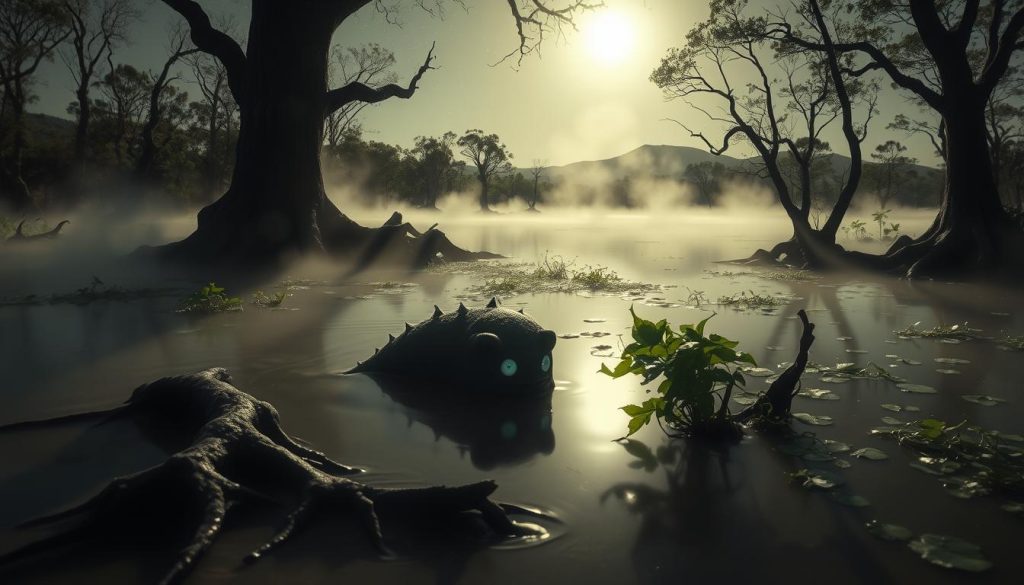
The bunyip is caught between Indigenous stories and settler curiosity. Early newspapers and sketches fueled public interest in monsters. This mix changed a cautionary tale into a famous creature.
Common Misconceptions Explained
Many think the bunyip is just an unknown animal. Scientists say it could be seals, the Australasian bittern, or echoes of extinct animals. Misidentified remains also added to the mystery.
An 1847 skull was once thought to be proof. But it was actually a deformed foetal specimen.
Settlers called the bunyip a “devil,” changing how people saw it. This label came from European views, not Indigenous ones. Seeing the bunyip only as a monster misses its deeper meaning.
Clarifying Common Misunderstandings
Mythology studies highlight the importance of context. The bunyip warns of dangers near water and teaches children. It’s a guardian figure, like in many cultures.
When cultures meet, myths evolve. Colonial press made sightings seem more common. Today’s movies and books often forget the bunyip’s true purpose and origins.
- Misidentification: Natural animals and sounds explain many sightings.
- Translation errors: European labels changed the creature’s social meaning.
- Cultural forgetting: Popular media sidelined original storytelling intent.
Understanding the bunyip requires field evidence and cultural respect. Studies help us see how myths form and why they last. This approach shows the importance of respecting stories and symbols.
Bunyips in Contemporary Society
The bunyip is alive in schools, museums, and books. It’s seen in stories by Jenny Wagner, Jackie French, Colin Thiele, and Michael Salmon. It also appears in animated films like Dot and the Kangaroo and at local festivals.
Today, the bunyip has many roles. It’s a fun character in kids’ media and teaches about wetlands. It’s also honored in cultural events and museums. People learn about it in classrooms, on family trips, and on tours of natural sites.
Modern Beliefs and Folklore
- Some Australians see the bunyip as a fun story for kids. These stories focus on wonder and creativity.
- Others view the bunyip with respect, linking it to Indigenous knowledge and stories.
- It’s also seen as a symbol for conservation and community identity.
The Bunyip’s Place in Australian Culture Today
- Tourism uses the bunyip to draw visitors to wetlands and museums.
- Schools and authors teach ethics, nature care, and history through the bunyip.
- Artists and curators show the bunyip alongside other mythological creatures in exhibitions.
Researchers study how the bunyip changes from myth to mascot. Folklorists track changes in its stories. Educators see how it teaches respect for nature. This mix shapes how we see stories and places in the future.
Conservation and Protection of Bunyip Habitats
The bunyip’s role in myths connects to caring for wetlands. Saving billabongs, riverbanks, and swamps keeps the stage for myths alive. This section talks about how we can help protect these areas and the creatures and symbols in local stories.
Ensuring the Future of Wetlands
- Keep important waterholes on the Murray and Darling rivers safe for habitats and cultural sites.
- Reduce pollution and stop runoff from farms to keep waterways good for platypus, birds, and fish.
- Control invasive plants and animals to protect native species and the landscapes tied to myths.
Community Involvement in Conservation
- Work with Indigenous people and local groups on projects that respect their knowledge and stories.
- Support education that teaches kids about the link between myths and taking care of land and water.
- Start eco-tourism and cultural projects that show off myth symbols without harming the environment.
Community efforts protect both the environment and the stories behind myths. Small actions over time can save wetlands and keep myths alive for generations to come.
The Legacy of Bunyips
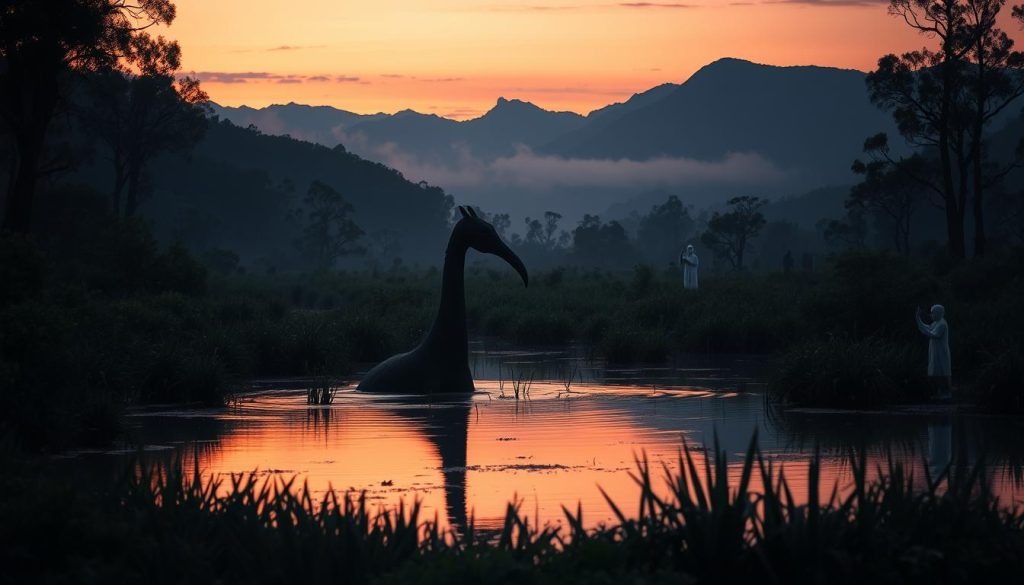
The bunyip’s story goes beyond just one tale. It shows up in stories, newspapers, museums, kids’ books, theater, and public art. These keep the myths alive, shaping how people remember them.
Continuing the Tradition of Storytelling
Stories of the bunyip are passed down from elders to the young. Schools, libraries, and the National Library of Australia add to these stories. This connects myths to local places and words, creating shared cultural symbols.
Future Generations and Bunyip Mythology
Research and exhibits mix old stories with new studies. Scholars and Indigenous leaders work together to keep the stories true. This ensures the myths stay meaningful, not just oddities.
Efforts to save wetlands where bunyip stories come from are underway. This protects the places and stories that matter. Young artists use these tales to make new works for theater, film, and learning.
In museums, classrooms, and community projects, the bunyip connects the past to the future. These efforts protect the stories and the places that inspired them.
Conclusion: The Enduring Mystery of Bunyips
The bunyip is a complex figure in Australian mythology. It is seen as a water spirit in Aboriginal dreaming and caught the interest of 19th-century colonizers. Its stories mix up real animals, fossils, and cultural tales. This mix shows why creatures like the bunyip are hard to explain.
Scientists have not found proof of the bunyip as a living creature. Yet, its place in mythology is undeniable. It taught people to be careful near rivers and swamps. It also helped connect Indigenous and settler cultures, shaping their shared history.
The bunyip’s value is not in being proven real but in its meaning. Its stories and deep roots in Indigenous culture keep it alive. The bunyip’s mystery shows how old myths and creatures can guide us, inspire, and link past and present.
FAQ
Q: What is a bunyip?
A: The bunyip is a creature from Aboriginal mythology in southeastern Australia. It lives in swamps and waterholes. The name comes from the Wemba-Wemba or Wergaia languages.
Stories say it’s an aquatic being with many forms. This varies by region.
Q: How do bunyips function in Indigenous culture?
A: Bunyip stories teach kids to stay away from dangerous waterholes. They also teach respect for waterways. In Ngarrindjeri dreaming, the bunyip is Mulyawonk, a water spirit.
These stories help protect wetlands and teach safety around water.
Q: When did Europeans first record the bunyip?
A: The bunyip was first mentioned in the Sydney Gazette in 1812. Many reports followed in the 19th century. They were in newspapers and museum displays.
Q: What kinds of physical descriptions exist for the bunyip?
A: Descriptions vary a lot. Some say it looks like a seal-dog, while others describe it as long-necked with a horse-like head. It’s also said to have starfish-like shapes and loud calls.
It’s often seen as a nocturnal, aquatic creature.
Q: Why do eyewitness reports of bunyips differ so much?
A: Reports vary due to different stories and misidentifications. Poor night vision and cultural memory of extinct animals also play a part. European settlers’ unfamiliarity with Australian animals added to the confusion.
Q: Could the bunyip be a real animal?
A: Scientists haven’t found proof of the bunyip as a species. Some think it might be an inland seal or a misidentified animal. Fossil finds and museum exhibits have fueled speculation.
Q: How did fossils and museum exhibits shape bunyip beliefs?
A: Fossils and museum exhibits in the 19th century sparked interest in the bunyip. Some suggested it was linked to extinct marsupial megafauna. Misidentified skulls also added to its mystique.
Q: What role did the bunyip play in literature and art?
A: The bunyip appeared in colonial newspapers and museum displays. It also showed up in children’s literature and stage works. Today, it’s in films, music, and public art, keeping its legend alive.
Q: Where are bunyip sightings most commonly reported?
A: Sightings are most common in southeastern Australia. This includes rivers like the Murray and Darling and billabongs and lagoons. Wetlands and creeks are often associated with bunyip lore.
Q: What environmental or social factors produced bunyip reports?
A: Nighttime conditions, seasonal animal movements, and settler unfamiliarity with the landscape contributed to reports. Misidentifications of native fauna and cultural exchange also played a role.
Q: How does the bunyip compare to other global cryptids like the Loch Ness Monster?
A: Like the Loch Ness Monster, the bunyip is an elusive aquatic cryptid. It has varied eyewitness accounts and strong cultural resonance. The bunyip’s deep Indigenous origins and role in cautionary narratives set it apart.
Q: Has the bunyip influenced Australian identity and place names?
A: Yes. The bunyip is in place names, newspapers, and local festivals. It’s also in children’s literature and public art. It’s part of Australian cultural identity, used in tourism and community projects.
Q: What are common misconceptions about the bunyip?
A: Many think the bunyip is just a monstrous unknown animal. Others translate it as “devil.” These views ignore its Indigenous cultural context and cautionary functions. Many 19th-century reports were misidentifications or sensationalized press items.
Q: How do modern Australians engage with bunyip stories?
A: Modern Australians engage with bunyip stories in many ways. They appear in children’s books, tourism, and serious cultural respect. Literature, film, and public art use the bunyip to promote wetland awareness and cultural heritage.
Q: What conservation relevance does bunyip mythology have?
A: Bunyip stories highlight the cultural importance of wetlands. They teach the need to protect billabongs, creeks, and river systems. Conservation efforts support biodiversity and cultural landscapes that produced bunyip narratives.
Q: How is bunyip lore preserved for future generations?
A: Bunyip lore is preserved through storytelling, children’s literature, and museum collections. Recent scholarship and community-led projects focus on respectful presentation of Indigenous contexts. This supports cultural preservation and cross-cultural understanding.
Q: Are there scholarly debates about the bunyip’s origin?
A: Yes. Researchers debate whether bunyip tales come from misidentified fauna, Indigenous memory of extinct megafauna, or social functions. Evidence supports long Indigenous storytelling traditions, but no scientific proof exists for a living bunyip species.
Q: Can the bunyip teach lessons beyond folklore?
A: Absolutely. Bunyip stories teach about water safety, sustainable resource use, and respect for country. They link mythology to environmental stewardship and cultural continuity. This offers a way to engage communities in conservation and heritage education.