The Piasa Bird lives in American memory as a dragon-like figure on the Mississippi banks. It ties place, memory, and local identity even when original records are thin.
This Ultimate Guide treats the Piasa Bird as myth and story rather than a strict true-or-false debate. It will define what a myth is, compare monster narratives across the world, and then draw parallels with Greek tales to show recurring patterns.
Readers will see why the creature can be called both a legend and a myth, and why that matters for how people interpret the past. The bird’s winged, monstrous form is more than decoration; it signals ideas about danger, place, and memory.
Along the way, the guide links culture and history by showing how local communities keep stories alive when documentation is scarce. It invites lovers of myths, folklore, and regional tales to read on.
Key Takeaways
- The Piasa Bird is a riverine, dragon-like figure tied to place and memory.
- This guide treats the Piasa Bird as myth and legend to deepen understanding.
- It will move from defining myth to comparing global monster stories.
- Greek parallels help reveal recurring narrative patterns and forms.
- The creature’s visual form communicates cultural meaning, not just fear.
- Local culture keeps these stories alive despite thin written history.
Why the Piasa Bird Still Matters in American Culture
The Piasa Bird endures as a local emblem along the Mississippi because it captures a shared way of naming place and danger. The creature functions less as a debated fact and more as a living myth that carries meaning for towns and river communities.
A Mississippi River “dragon” and what it reveals about regional identity
The Piasa acts as a cultural shorthand for river towns. It bundles pride, caution, and local distinctiveness into one striking image.
People use the bird to explain boundaries and fears. The focus is not on proving the creature but on how the myth reflects community identity and values.
How stories survive when histories fade
When written records thin, myths keep memory alive. Repetition in oral retellings, murals, classroom mentions, and tourism language keeps the tale in circulation.
- Retellings and local art
- Tourism and classroom lessons
- Online sharing and regional events
These myths and stories do work: they compress history, anxiety, and pride into a memorable form. Later sections will link this American monster to Greek parallels to show how communities worldwide use similar narrative tools.
What Mythology Means
Stories that bind a place to its past often do more than record facts—they shape shared meaning. A myth works to order experience, explain danger, and set expectations for behavior. In that sense, how true a tale is factually matters less than what it does for the people who tell it.
Myth as a folklore genre
Mythology is the collection of a group’s myths. Academics do not use the word to mean “false stories.” Instead, mythology points to narratives that communities treat as explaining origins, sacred order, or the deep past.
Myth, legend, and folktale
A simple distinction helps. Myth often centers non-human figures like gods and sacred stakes. Legends focus on humans and local history. Folktales lean toward entertainment and flexible belief.
Ritual, authority, and social effect
Religious myths often gain power when leaders or institutions endorse them. That authority turns story into practice: a myth ritual repeats, reinforcing norms and values. Even a local creature like the Piasa Bird can function as a myth if it explains danger, marks boundaries, or shapes community identity.
The Piasa Bird as a Myth and a Legend
The Piasa Bird can read like a hometown warning or a distant sacred tale, depending on who tells it. In some towns the story functions as a simple legend—a local warning about river danger. In others, it acts like a myth, explaining boundaries and communal values in a way that feels older and deeper.
Legendary creature vs. deity-centered stories
Myths often use non-human figures such as gods and spirits. Legends usually highlight humans. The Piasa sits between these forms: it is a dragon-like creature in form, not a god, yet it performs myth-like social work.
Monsters, humans, and shifting characters
Non-human protagonists matter because monsters let people speak about fear, difference, and risk. The Piasa externalizes river danger and otherness, helping humans name what they are not.
Across retellings, focus moves. Sometimes humans take center stage as victims or heroes. Sometimes the creature becomes the main character. That shift changes the story’s moral and function.
- The Piasa can be a local cautionary tale or a sacred sign.
- Monster-centered tales do symbolic work a god-centered myth might handle differently.
- Its dragon-like image connects the bird to similar creatures worldwide.
Origin Stories and the Mississippi River Setting
Along great waterways, origin tales grow from the mix of bounty and risk the river brings. Rivers give food, travel routes, and landmarks. They also flood, hide shoals, and cut new channels. That push-pull makes them perfect engines for myths and origin explanations.
Why rivers generate powerful origin myths and local legends
The Mississippi feels like a place of creation and change. In origin stories, the river stands as a source of life and a border that must be respected. Communities imagine a remote past when the world was wilder and rules were first set.
Place-based storytelling and “remote past” worlds
Linking tales to cliffs, bluffs, and bends turns memory into apparent evidence. A named bluff or river bend becomes proof for how customs began, why taboos exist, and what dangers to avoid.
How communities connect myths, legends, and history
Monster stories like the Piasa follow the same creation logic: they explain why a place feels the way it does and why people must act certain ways near the water. River myths often echo older sea narratives, so freshwater and coastal tales speak to shared water-based origins.
- Rivers: life-giving, dangerous, boundary-making.
- Origin patterns explain customs and local taboos.
- Place anchors stories, making them feel like living history.
Key Themes in the Piasa Bird Story
At its core, the Piasa story centers on danger, image, and the rules a community lives by. These themes explain why the tale keeps appearing in local talk and art.
Fear, protection, and boundary-making
Fear in monster narratives turns private anxieties into a public sign. The Piasa becomes a shared image for hazards that are hard to control: heights, water, and unknown territory.
Myths then act as maps. They mark safe versus unsafe zones and guide how humans behave near risky places.
Body, flight, and visual form as meaning
The creature’s body — wings, claws, hybrid features — speaks faster than words. Its form signals power, predation, or taboo.
- Wings suggest flight and boundary crossing.
- Claws and beak point to predation and danger.
- Hybrid anatomy makes the creature memorable.
Fire, danger, and the lure of the forbidden
Fire shows up as both threat and temptation. In many myths, fire marks taboo-breaking and earned knowledge.
Forbidden-lure stories warn but also invite imagination, which is why such tales stay alive in stories shared online and in person. The Piasa’s themes still shape what people pass on in the modern world.
How Myths Work: Ritual, Authority, and Social Order
When leaders or institutions retell a tale, it stops being just a story and becomes part of civic life. Repetition by schools, churches, or town halls makes a narrative durable. That authority helps stories do social work: they teach rules, mark danger, and bind communities.
How authority shapes shared stories
Institutions make a myth stick. When a city puts a creature on signs or a school reads the tale aloud, the story becomes an unofficial rulebook.
Public endorsement turns private memory into public order. Over time, myths guide behavior more than laws do.
Recital, ritual, and everyday practice
Hearing a story again and again works like a myth ritual. Simple repetition—at festivals, media, or class—creates a rhythm that people follow.
These enactments can be secular or sacred. They feel like ritual even when no altar or priest is present.
Scale: national myths and local legends
National myths package a country’s values and identity. Local myths protect place-based memory and warn about specific risks.
- National stories shape citizenship and broad identity.
- Local tales, like the Piasa Bird, anchor a town’s culture and cautionary lessons.
- Both kinds turn real events into symbols by simplifying details.
In short, whether told in a classroom or at a festival, these myths and rituals make memory live. The Piasa’s repeated retelling in tourism, school lessons, and media acts as a civic ritual that keeps the past present.
Mythology Across the World: Where the Piasa Bird Belongs
People around the globe build creatures into stories when landscape or danger needs naming. Seeing the Piasa Bird beside other traditions helps readers place a local tale in a global map.
North American traditions on the global map
North American myths sit alongside African, European, Asian, Oceanian, Middle Eastern, and South American bodies of story. Each region frames land, water, and social rules in ways that fit local life.
Why legendary creatures appear everywhere
Legendary beasts concentrate fear, teach norms, and dramatize boundaries in a single image. Many traditions include gods and goddesses, yet creature-focused tales do the same social work.
- Place the Piasa with other regional traditions to see shared patterns.
- Water settings—river or sea—often spawn edge-guarding creatures.
- A short comparative method, not forced one-to-one matches, yields the best insights.
Comparative Mythology: Piasa Bird and Dragon-Like Creatures
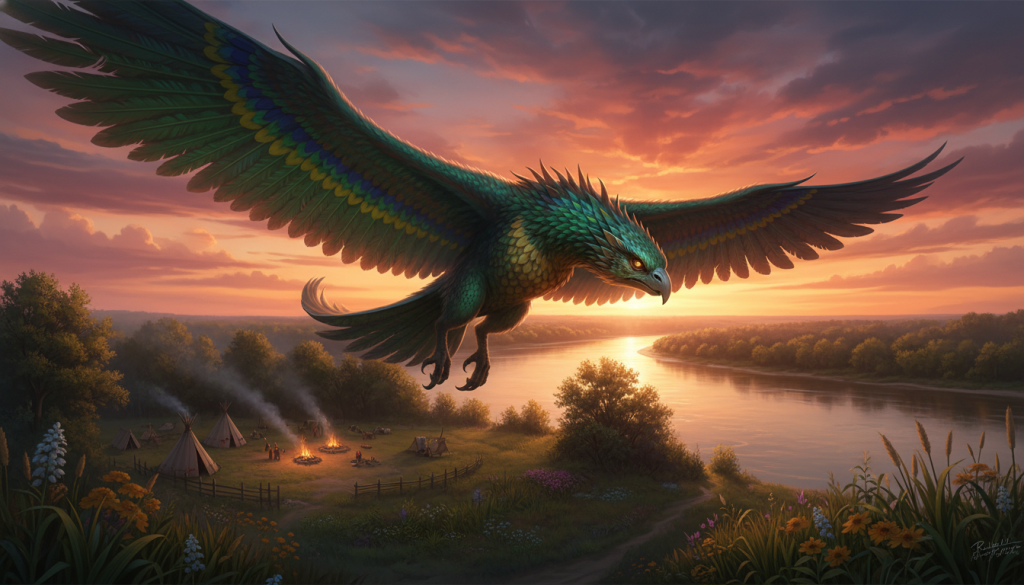
Scholars compare tales to find the common bones that lie under surface detail.
Comparative study looks for shared themes across cultures. It does not claim every group copied another. Instead, it traces repeated patterns in how people explain danger and place.
What comparative work seeks
Researchers map basic units called mythemes. These are building blocks like “boundary crossed” or “community threatened.” Add a few mythemes and a full narrative emerges.
Common mythemes in monster tales
- Boundary crossed — the creature breaches a safe zone.
- Taboo violated — rules are broken, causing trouble.
- Community threatened — people face collective danger.
- Restoration attempted — action restores order.
Stories in different times and places can vary in detail yet share the same configuration of mythemes. That shared shape is what lets scholars call two accounts variants of the same myth.
Applied to the Piasa Bird, likely mythemes include warning, place-guarding, punishment, and fascination. These link the Piasa to dragon-like characters worldwide and set up the Greek parallels ahead.
Greek Mythology Parallels That Clarify the Piasa Bird
Reading Greek accounts alongside the Piasa tale shows how communities shape danger into story. Classical patterns act as a clarifying mirror, not a claim of direct descent.
Chaos to order: Hesiod’s creation arc
Hesiod begins with Chaos, then Earth, sky, Titans, and finally Zeus on Olympus. That move from disorder to rule helps explain why communities tell origin-like stories to tame fear.
Fate and inevitability: the Moirae
The Moirae—Clotho, Lachesis, Atropos—make fate feel binding for gods and humans. Monster tales often carry this sense of inevitability: crossing a line brings consequences that feel preordained.
Fire, Prometheus, and taboo-breaking
Prometheus steals fire for humans and is cruelly punished by Zeus. Fire here stands for forbidden power: taking it brings both help and danger. That dual role matches Piasa themes where transgression yields risk and allure.
Pandora and the one-act disaster
Pandora, made by Hephaestus and gifted by the gods, opens a jar and releases ills into the world. Many local warnings follow this template: one curious act unleashes trouble.
Heroes versus monsters: Theseus and the Minotaur
Theseus uses Ariadne’s thread to defeat the Minotaur and restore safety. Communities imagine similar restorations: a hero figure who confronts a non-human threat and repairs order.
- Greek mythology offers reusable narrative tools.
- Chaos-to-order, fate, taboo, and hero action appear as clear patterns.
- These patterns clarify why monster myths keep meaning across time and place.
Gods, Heroes, and Monsters: Why Humans Need Them
People build characters—divine, heroic, and monstrous—to teach what matters in their world. These figures act as social tools that show praise, fear, and taboo in simple stories.
How divine and semi-divine characters shape moral worlds
Gods and semi-divine figures model ideals like courage, sacrifice, and cleverness. When a community praises a god or marks a hero, it signals the traits people should honor.
Heroes mirror strengths and human flaws. Their deeds teach rules by example. In this way, heroes guide others without formal law.
Why monsters endure when gods change
Religions shift, but monsters keep working. A monster dramatizes danger, boundaries, and social rule-breakers more flexibly than a god can.
Love often drives these plots—devotion, jealousy, or protection push heroes into action and set gods against one another. That emotional engine helps myths and myths survive.
- Monsters dramatize consequences for humans who cross lines.
- Heroes and gods offer ideals; monsters test them.
- Even without a named god, a creature like the Piasa shapes local moral order.
In short, humans do not outgrow these figures. They swap names and settings, but gods, heroes, and monsters keep explaining how a culture faces fear, love, and the unknown world.
Oral Tradition, Stories Told, and How the Piasa Changes Over Time
Stories passed by word of mouth change with each telling, and the Piasa is no exception. Oral tradition kept river tales alive when books did not exist. That process naturally reshapes a tale as it moves through people and places.
How myths travel, merge, and shift into folktales
When a story travels, it borrows local names, landmarks, and motives. Oral tradition lets a myth absorb place-based detail until the creature feels rooted in one town.
Why variants multiply across communities and times
Different listeners stress different dangers. Some communities want a warning; others want a thrilling tale. That is why many stories told end up as multiple versions. Over the years, divine figures can become semi-human or fully human in retellings.
Plot changes vs. core themes
Plot points—names, set pieces, and scenes—float. The emotional core stays: warning, boundary-making, identity. Myths and myth-like tales keep that core even as details drift toward folktale humor or legend-style local history.
- Oral tradition reshapes a tale every time it is repeated.
- Stories told in new places pick up local color and new fears.
- The Piasa survives as symbol, tourist icon, or cautionary monster without losing its part as a communal warning.
Sources, History, and How to Read Myth Responsibly
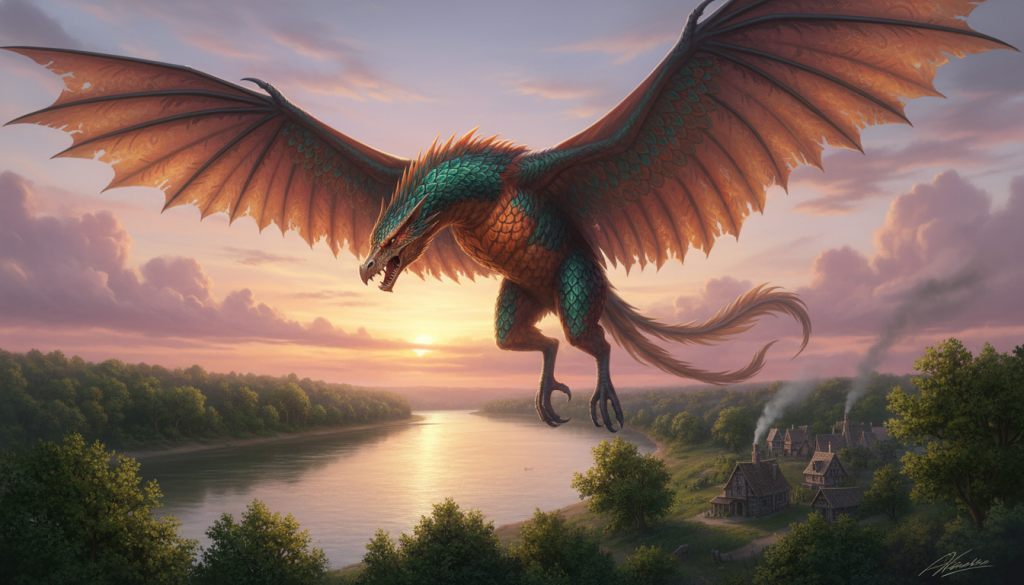
Reading a myth responsibly starts with asking what counts as evidence when written history is thin. A clear approach helps readers weigh different kinds of sources without forcing a binary of true or false.
What counts as a source when texts are scarce?
Useful sources include manuscripts, recorded versions, and repeatable motifs found across tellings. Community transmission—stories told at festivals, in classrooms, or online—also functions as evidence of a tale’s role.
Oral patterns that recur give scholars clues about age and function even if firm dates are missing.
Why scholars disagree about definitions
Definitions of myth vary because scholars ask different questions. Some focus on origin claims, others on social function or poetic form.
That choice changes what gets labeled myth or legend, and how the history of a story is written.
Mythography and the value of compiling versions
Mythography—the work of collecting and describing versions—preserves diversity. Classical authors like Ovid and Fabius Planciades Fulgentius show how compilers shape meaning as much as they record it.
Long-form texts, such as an epic poem, often preserve myths while adapting them for new audiences.
- Sources = documents, recordings, motifs, community transmission.
- Read myths without insisting on literal history or dismissing cultural value.
- Compilations help readers see how one tale becomes many.
For the Piasa Bird, this means the guide will treat uncertain history honestly while using careful sources to draw cultural insight. That balance lets readers learn what the myth tells about a place and its people.
Epic Storytelling and the Power of Long-Form Myth
Long-form tales have a rare power: they make scattered episodes into a single, lasting world.
Epic poem traditions anchor a people by fixing heroes, events, and values into a shared narrative. Works like the Iliad and Odyssey shaped memory across generations. They stabilized oral layers into texts that readers returned to again and again.
Why epic poems become cultural anchors
The Theogony and Homeric epics collected origin stories and heroic deeds into a coherent past. An author name—Homer or Hesiod—does not erase older oral roots. Instead, the poem records a living stream of tales.
How epic form organizes heroes and events
Epics shape many small incidents into an ordered arc. Repetition, shared quotations, and ritual recitation create a canon. Readers learn to spot “epic effects”—a fixed cast of heroes, linked events, and a single imagined world that guides belief and behavior.
- Anchor: canon and repeated lines
- Structure: ordered events and moral frames
- Legacy: modern long-form media can work the same way
Though the Piasa Bird is not an epic, long-form films, novels, and serial podcasts can remythify local tales in similar fashion.
Modern Remythification: How Pop Culture Revives Old Monsters
Pop culture often rewires old monsters into new forms that feel familiar to modern audiences.
Remythification means older myths re-enter culture through series, fandom, and deliberate world-building. Franchises create a shared mythos—an interconnected set of tales that functions like a contemporary mythology.
Mythos and series world-building
Modern series weave motifs into long arcs. Shared characters, rules, and quests make a new cultural world that audiences inhabit and expand.
Percy Jackson as an American gateway
Percy Jackson brings greek mythology and the greek pantheon to young readers through fast plots and humor. It recycles quest templates—the golden fleece and Jason Argonauts-style team journey—so ancient themes feel immediate.
Music, art, and the Internet as rituals
Music, art, memes, and online communities act as modern storytelling rituals. Repetition, remix, and fan love keep myths alive and allow a local creature like the Piasa Bird to be reborn in games, shows, or serialized fiction without losing place-based identity.
- Franchises make living myth systems.
- Percy Jackson shows how classics re-enter school reading and fandom.
- Love—romantic or communal—drives retellings and keeps stakes human.
Visiting the Mississippi: Experiencing the Piasa Bird Legend Today
Seeing the Piasa image in person helps, but listening to local voices reveals the story’s work. A mindful visit mixes landscape reading with attention to how people tell the tale.
What to look for when exploring mythic places in the United States
Notice signs, museum displays, and murals. Check plaques for dates and the names of storytellers or historians.
Watch how the bluff, river bend, or trail is described. Landscape cues often anchor the myth to lived place.
How to separate tourism lore from deeper cultural meaning
Ask three simple questions: who tells the story, who is the audience, and what is the story meant to do—warn, amuse, or unite?
- Listen for stable details repeated by many local people; those are signals of living myths.
- Respect the coexistence of legend and history: both can inform community identity.
- Remember water imagery. River travel shares themes with the sea—crossings, thresholds, and sudden danger.
Avoid shallow consumption by learning context, noting community memory, and asking how the story shapes culture today. Visitors become part of the story’s survival simply by paying attention.
Conclusion
The Piasa Bird shows how a single image can hold a community’s warnings, values, and memory.
The main takeaway: the Piasa works as myth in action — a story that helps humans name danger, mark boundaries, and shape local identity when written history is thin.
Seen globally, gods, monsters, and heroes repeat because they compress social meaning into memorable characters. Greek parallels — creation-order logic, fate, taboo-fire, unleashed disaster, hero versus monster — clarify structure without claiming direct borrowing.
Keep a short mental list when reading any myth: core themes, repeatable mythemes, local variants, and the gap between plot detail and lasting meaning.
Finally, remember that love for stories drives survival. People repeat what moves them, and that is why myths remain part of modern life.
FAQ
Q: What is the Piasa Bird and where does the story come from?
A: The Piasa Bird is a legendary dragon-like creature linked to the Mississippi River near Alton, Illinois. European settlers recorded an image painted on cliffs and told stories passed down among local Native American communities and early explorers. Over time oral tradition, traveler accounts, and antiquarian descriptions shaped the modern legend.
Q: Why does the Piasa Bird still matter in American culture?
A: The Piasa Bird matters because it connects place, identity, and storytelling. It anchors regional identity along the Mississippi, inspires local art and tourism, and shows how communities use a shared tale to mark boundaries, warn of danger, and preserve memory across generations.
Q: How does this creature fit into the difference between myth, legend, and folktale?
A: The Piasa Bird sits between legend and folktale: it’s tied to a real place and historical impressions (legend) yet shaped by imaginative details and oral variants (folktale). Unlike deity-centered myths, it centers a monstrous figure and human responses, revealing social values more than cosmology.
Q: Are there Greek parallels that help explain the Piasa Bird story?
A: Yes. Greek stories such as Theseus and the Minotaur or Prometheus and the theft of fire offer useful comparisons. They show recurring themes—heroes vs. monsters, taboo-breaking, and disorder turned into order—that clarify how societies frame danger and moral lessons.
Q: Why do rivers like the Mississippi inspire origin stories and monsters?
A: Rivers shape landscapes, livelihoods, and danger, so communities project meaning onto them. Waterways become settings for boundary-making, origin myths, and tales of protection or threat. The Piasa legend uses the Mississippi’s scale and mystery to dramatize local experience.
Q: What themes are central to the Piasa Bird tale?
A: Key themes include fear and protection, the monster’s body and flight as symbolic form, fire and danger as forbidden allure, and how communities respond to threats. These motifs carry moral lessons about courage, boundary-setting, and social order.
Q: How do myths like the Piasa Bird influence ritual and authority?
A: Local leaders, religious figures, or storytellers often endorse versions of a tale to support social norms. Recital of stories can accompany ceremonies or memorials, reinforcing authority and shared values. National and local myths operate at different scales but both shape behavior.
Q: Where does the Piasa Bird fit in a global map of legendary creatures?
A: The Piasa Bird belongs to a broad family of dragon- or monster-like beings found worldwide. Comparing it to North American and Eurasian creatures highlights shared mythemes—boundary guardians, chaos embodiments, or tests of heroism—showing cross-cultural patterns.
Q: How do scholars study variations of the Piasa Bird across time?
A: Researchers trace oral tradition, historical reports, illustrations, and written accounts. They distinguish plot additions from core themes, assess transmission paths, and evaluate sources—archival records, ethnography, and local histories—to reconstruct how the story changed.
Q: Can the Piasa Bird story be connected to ancient epics like the Iliad or the Odyssey?
A: While different in scale, the Piasa tale shares epic functions: shaping collective memory and modeling conflict between humans and dangerous forces. Studying epic techniques—symbolic monsters, heroic trials, and cultural anchors—illuminates how local legends perform similar roles.
Q: How has modern pop culture affected the Piasa Bird and similar tales?
A: Contemporary media—books, art, music, and online platforms—remythify older stories, adapting them into series, music, or local attractions. Works like Rick Riordan’s Percy Jackson revive interest in mythic frameworks, encouraging new retellings and broader awareness.
Q: What should visitors look for when exploring sites tied to the Piasa legend?
A: Visitors should seek historical markers, museum exhibits, and reputable local guides to distinguish tourism lore from deeper cultural meaning. Observing the river landscape, local artwork, and archive materials helps appreciate both the tale’s aesthetic impact and its social context.
Q: What sources are reliable when researching the Piasa Bird?
A: Reliable sources include archival documents, museum records, ethnographic studies, and peer-reviewed scholarship. Eyewitness accounts and historical illustrations are useful but require contextual evaluation. Mythography that compiles versions can show how the narrative evolved.
Q: Why do monsters like the Piasa Bird endure even as gods and religions change?
A: Monsters persist because they embody social anxieties, moral lessons, and dramatic spectacle. They require no formal cult; they function as narrative tools that adapt easily across media, keeping core fears and warnings alive even when formal beliefs shift.