This page shows how real animals and the fossil record shape the idea of “dragon bones” in modern fantasy. It promises clear, evidence-backed links between fossils and the myths that spark wonder. The goal is to let readers enjoy magic while keeping scientific credibility.
“Dragon bones” usually mean mysterious giant bones, misidentified fossils, and oversized skulls found in folklore and museums. The section explains why these finds repeat across books, games, film, and branded content.
The article is also a service-first resource for creators and brands. It acts as a blueprint for science-accurate worldbuilding that performs in search. Readers will see how fossils and real animals inform repeatable publishing systems, from feature articles to weekly content cycles.
This content caters to a United States audience with clear sourcing, plain explanations, and practical formats that help teams publish without sounding like an ad. It prepares readers for a journey from bones to brand storytelling in modern fantasy work.
Key Takeaways
- Real fossils and animal remains often explain “dragon bone” myths.
- Evidence can enhance wonder without losing scientific credibility.
- Creators and brands get a practical blueprint for accurate worldbuilding.
- The article links fossils to repeatable publishing systems for content teams.
- Style and sourcing are tailored for a US audience with commercial needs.
Why “Dragon Bones” Persist in Modern Storytelling and Media
Mysterious fossils travel fast in modern media, turning curiosity into viral legend. A striking find makes an easy hook, and that hook often spreads as news before scientists weigh in.
When buzz outruns verification, readers get a simple narrative: discovery, drama, and mystery. That loop feeds fandoms and general audiences alike. Creators can use that momentum by contrasting what people think they saw with what the evidence actually shows.
- Why it sticks: Mystery is shareable and headline-ready.
- US reader expectations: transparent sourcing and clear lines between fact and speculation win trust.
- Brand angle: research-backed storytelling with accessible citations converts curiosity into credibility.
The same audience that chases weekly rumors in fantasy football also follows creature stories. They reward content that separates signal from hype and that phrases uncertainty plainly: “here’s what we know.”
The Fossil Record Behind Legendary Creatures
Broken bones in odd places often read like a story rather than a specimen. When fossils are found alone, their scale and wear shift how people describe them.
Common finds mistaken for monsters
Large vertebrae, long ribs, horn-like fragments, and oversized limb bones top the list.
Skull pieces can look like beaks or jaws when erosion removes familiar landmarks.
Why size and damage warp perception
Scale tricks the eye: an enormous bone with no context becomes a creature in the mind.
Fragmentation, mineral staining, and missing joints create shapes that resemble claws, plates, or spines.
Where science and imagination split
Museum science relies on taxonomy, comparative anatomy, and peer review to test identity.
Creative interpretation borrows those shapes and adds behavior, movement, or breath that fossils cannot show.
- Writers can stay accurate by using real bone function.
- They can still invent dramatic traits for fantasy audiences.
- This balance supports believable worldbuilding that respects evidence.
Real Animals That Likely Inspired Mythological Beasts
Modern mythmakers borrow real-world anatomy to make beasts that feel physically plausible.
Big cats, snakes, and crocodilians as templates for scaled monsters
Big cats supply hunting posture, powerful forelimbs, and silhouettes that read as apex predators.
Snakes contribute a visual language of scales, coiling motion, and sudden strikes that signal danger.
- Stalking and pounce dynamics from felids
- Constricting shapes and venom cues from serpents
- Armored hides and ambush tactics from crocodilians
Large birds and bats as the origin of winged-beast imagery
Birds and bats explain wing joints, feather or membrane textures, and aerial hunting tactics.
Talons, beaks, and shadowy flight patterns make winged creatures feel functional and threatening.
The aim is not to strip wonder away. It is to give creators tools to build believable monsters that hold attention and share well when grounded in real anatomy.
Fantasy as a Service: Turning Science-Accurate Lore Into High-Performing Content
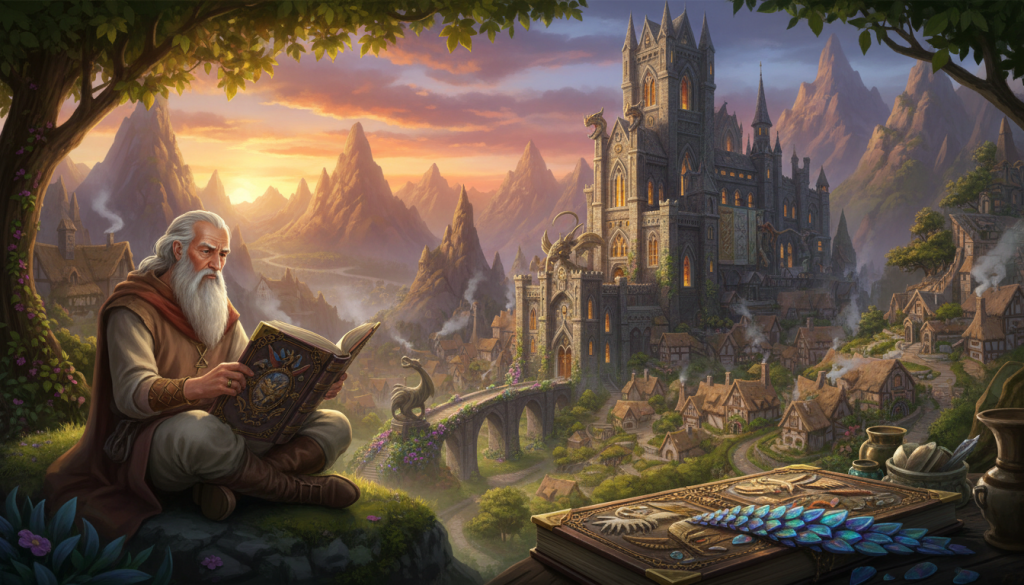
Science-informed storytelling can be packaged as a repeatable content product that attracts organic traffic and qualified leads. This approach treats accurate lore as a service: useful, discoverable, and ready to convert.
SEO topic clustering that connects evidence and myth
The strategy links pages about fossils, dragon bones, comparative anatomy, and mythic archetypes. Internal links reinforce relevance and help search engines understand authority.
Editorial positioning for creators and brands
Options include educational authority, research-backed entertainment, or “myth meets museum” storytelling. Each choice guides tone, sources, and calls to action for a US audience.
Voice, formats, and subtle conversion
Use friendly third-person narration with short paragraphs, defined terms, and qualifiers like likely and plausible. Offer conversion assets that feel helpful: downloadable lore briefs, museum-style fact cards, and interactive quizzes. Prioritize usefulness, then invite the reader to request strategy or production support.
From Ancient Myths to Today’s Fantasy Football News Cycles
Timely interpretation turns fragments into narratives, and audiences follow those shifts week to week. Like oral storytellers, modern coverage asks: what changed this week, and why does it matter?
Buzz vs. noise is a simple framing borrowed from ESPN Fantasy analysis: highlight what alters decisions and set aside chatter that only excites. For example, headlines about a player’s free agency or off-field controversy become useful only when they affect team roles or season outlook.
Creators can follow a weekly rhythm. Publish short “myth updates” tied to new finds, scholarly debate, or design tweaks. Treat each update like game coverage: what changed, who benefits, and what to watch next.
Player arcs, applied to beasts
- Origins: how the creature first appears in lore.
- Rise: peak power or notoriety.
- Weakness: vulnerabilities revealed by evidence.
- Comeback & legacy: reinterpretations across a season of updates.
This cadence echoes fantasy football and premier league cycles. Readers already expect weekly news on players and games, so the same format makes myth-lore feel current and bingeable.
Rankings, Drafts, and Leagues: Building a Repeat-Visit Content Engine
Draft-ready lists create habit: readers bookmark them, return to compare, and share updates when opinions shift. That behavior drives reliable seasonal traffic and makes a site the go-to reference for a year-long audience.
How rankings pages drive seasonal return traffic
Rankings act like living documents. As injuries, trades, and new research arrive, readers revisit to see how a list changed.
ESPN’s “Top 300” model shows how a single draft companion becomes a draft-day staple for fantasy baseball managers. The same pull applies to creature or fossil hub ranking pages.
Draft-season planning for 2026 fantasy football hubs
Plan a content calendar with pre-draft primers, tiered lists, sleeper picks, and post-draft recaps labeled for 2026 fantasy football. Translate those formats to creature tiers, archetype drafts, and “best-in-biome” picks to keep momentum.
League-specific landing pages for better conversion
Create landing pages by ruleset, audience age, or platform. These pages improve conversion and strengthen internal linking between hubs and supporting articles.
Game-by-game templates that scale
Use repeatable pieces like “Creature of the Week,” “Evidence Report,” and “Lore Impact” to cover each game or matchup in a season. Consistent templates reduce editorial friction and keep readers coming back on a predictable rhythm, similar to premier league weekly coverage.
Start/Sit Decisions, Injuries, and the Offseason: Keeping Engagement Year-Round
Start-or-sit pieces give readers quick, practical calls tied to evidence rather than hype. Use the familiar sports hook—should you start a player this week?—to test claims about a creature or a fossil find.
Start ’Em, Sit ’Em-style decision content that maps to “evidence vs. belief”
Frame the claim: state the start or sit recommendation plainly.
Show the evidence: list what supports the choice and what would falsify it.
Use the Trevor Lawrence benching example: a hot streak can still be a sit if context changes. The same logic tempers dramatic fossil claims.
Injuries and availability as a modern “monster weakness” narrative device
Availability drives value. When players are injured, analysts note how limited minutes shift outcomes.
Translate that into story beats: torn wing membranes, seasonal torpor, and damaged limbs become believable weaknesses to explain behavior.
Offseason content that sustains traffic when games pause
Publish draft previews, retrospective rankings, and early 2026 fantasy football-style lists to keep readers engaged. Run polls, reader re-ranks, and league challenges to maintain community momentum and support commercial deliverables like templates and calendars.
Workflow, Deliverables, and What Clients Receive

A clear workflow turns creative briefs into publish-ready pages that rank and convert. This section lists what clients get, how quality is assured, and how hubs stay fresh over time.
Discovery: audience, competitors, and keyword alignment
The discovery phase defines the US target audience, maps direct competitors in science-lore and genre coverage, and sets realistic keyword goals.
Deliverables: audience profiles, competitor gap map, and a prioritized keyword list tied to intent and capacity to rank.
Outline-to-publish pipeline with editorial QA and source handling
Workflows use structured briefs, an editorial calendar, and staged QA to maintain speed and accuracy.
- Structured brief with angle, sources, and CTAs
- Drafting, fact-checking against museum and academic sources
- Editorial QA: style, claims review, and citation checks
On-page SEO: titles, headers, schema options, and internal-link plans
On-page deliverables include meta title/description drafts, clear header hierarchies, and suggested schema (Article, FAQ) where useful.
Internal-link plan: a 3–5 page cluster map that protects URL equity while enabling seasonal updates and expansions for 2026 fantasy hubs.
Conclusion
Tying legends to identifiable animals and fossils makes imagined beasts feel earned, not random. This throughline shows how real anatomy and the fossil record anchor believable creature design and strengthen modern fantasy storytelling.
Good “dragon bones” narratives balance wonder with constraints. They say what is known, note what is likely, and make clear what is intentionally invented. That clarity builds trust and shareability.
The same cadence used in draft and rankings culture—regular updates, clear changes, and living lists—keeps readers returning to science-accurate lore.
Next step: apply the templates, topic clusters, and editorial plan described here. For teams ready to scale, request a discovery call or a scoped package (pillar page + supporting cluster + seasonal update plan) to build a durable search presence.
FAQ
Q: How can fossil discoveries explain dragon and sea-monster legends?
A: Paleontologists note that large bones, partial skeletons, and marine vertebrate remains often look unfamiliar to nonexperts. When people in the past found isolated ribs, skull fragments, or long limb bones, they sometimes interpreted them through the lens of local stories, creating dragon- or leviathan-like accounts. Museums and field reports now connect many of those finds to known taxa such as large marine reptiles, cetaceans, or extinct megafauna.
Q: Why do dragon-like myths keep appearing in modern books, games, and film?
A: Cultural transmission and strong archetypes make scaled, winged, or serpent-like creatures compelling across eras. Creators reuse evocative elements because audiences respond emotionally to powerful, animal-rooted imagery. Accurate science enhances that appeal: grounded details about real animals lend credibility and depth to fictional beasts.
Q: How does "buzz" around a new fossil outrun verified facts?
A: Excitement spreads fast through social media and headlines, often before peer-reviewed descriptions appear. Preliminary finds may get sensationalized, and speculative visuals or claims gain traction. Relying on museum releases, preprints, and expert commentary helps separate hype from responsible interpretation.
Q: What do U.S. audiences expect from evidence-backed mythic content?
A: Readers want clear sourcing, vivid storytelling, and accessible science. They favor pieces that balance wonder with accuracy, explain how conclusions were reached, and show real-world examples that inspired fictional elements.
Q: Which fossils were historically mistaken for dragons or sea monsters?
A: Whale bones, giant ground sloth remains, mammoth tusks, and plesiosaur-like fragments commonly fueled monster tales. Isolated large vertebrae or limb bones can be misread as enormous serpents or winged beasts without comparative anatomy and stratigraphic context.
Q: How do bone condition and context change interpretations?
A: Weathering, erosion, and crushing alter bone shape; fragmentation removes diagnostic features. Without a full skeleton or stratigraphic data, people fill gaps with familiar motifs. Museum curation and careful excavation reduce misidentification by preserving context and allowing proper comparison.
Q: Where does museum science stop and creative interpretation begin?
A: Museums present evidence, reconstructions, and conservation facts. Creative interpretation adds narrative, aesthetics, and speculative life appearance for exhibits or media. Good practice labels reconstructions clearly and distinguishes hypothesis from established anatomy.
Q: Which living animals most influenced mythic scaled and serpentine creatures?
A: Crocodilians, large snakes, and big cats provided tactile models for jaws, scales, and predatory behavior. Observations of these species fed oral traditions that amplified size and danger over generations.
Q: How did birds and bats shape the idea of winged beasts?
A: Large raptors and flying foxes offered a template for wings, flight posture, and hunting silhouettes. Exaggeration of wingspan and teeth combined attributes from multiple taxa into a single imagined monster.
Q: How can creators turn accurate natural history into high-performing content?
A: They should cluster topics that connect fossils, mythic archetypes, and cultural history, then map those clusters to search intent. Using clear editorial positioning, consistent voice, and accessible explanations helps content rank and convert without feeling promotional.
Q: What editorial guidelines help a friendly third-person narrator?
A: Maintain an objective but warm tone, use short paragraphs, and avoid jargon. Cite sources, explain technical terms briefly, and keep sentences active. This approach builds trust and keeps readers engaged.
Q: Which content formats convert best for this niche?
A: Long-form explainers, visual galleries, interactive timelines, and FAQ-style quick answers work well. Lists and how-to pieces—like “how to read a fossil”—meet commercial intent while staying informative.
Q: How can "buzz vs. noise" framing be used in weekly sports or lore updates?
A: Label fresh claims clearly, present the evidence, and rate credibility. In sports reporting, that means separating hot takes from data-backed projections. In mythic reporting, it means distinguishing confirmed finds from speculative reconstructions.
Q: How do weekly updates mirror oral tradition in storytelling?
A: Small new details accumulate, and community discussion reshapes interpretation over time. Regular updates allow authors to refine narratives as new evidence or analyses emerge, much like storytellers refining tales across retellings.
Q: Can player-story arcs inform mythic-beast narratives?
A: Yes. Long-form arcs—rise, conflict, setback, comeback—translate well from athlete careers to creature myths. That structure helps audiences invest emotionally in both real people and legendary beasts.
Q: How do rankings and draft guides drive repeat traffic?
A: Regularly updated ranking pages become seasonal destinations. Fans return for draft prep, injury changes, and matchup previews. The same cadence applies to mythic content—periodic updates on new finds or reinterpretations keep readers coming back.
Q: What should 2026 draft-season planning include for sports and lore sites?
A: Build cornerstone pages that capture seasonal intent, schedule rolling updates, and prepare quick-hit briefs for major events. For both sports and natural-history coverage, prioritize mobile-friendly formats and fast-loading visuals.
Q: How do league-specific pages improve conversion and SEO?
A: Tailored landing pages match user intent, increase relevance, and allow internal linking to broader content. Personalized advice—strategy, roster moves, or exhibit highlights—encourages return visits and deeper engagement.
Q: What templates scale for game-by-game coverage across seasons?
A: Use repeatable blocks: quick summary, key takeaways, evidence or stats, and next-steps. Templates speed production while keeping voice consistent and making internal linking predictable.
Q: How do start/sit decision pieces relate to evidence vs. belief?
A: They translate statistical evidence into actionable guidance while acknowledging uncertainty. Framing decisions around known risks and historical trends helps readers choose confidently when data is limited.
Q: How can injuries be framed as "weaknesses" in creature narratives?
A: Injury reports highlight vulnerabilities and influence strategy or storyline. Treating availability as a narrative pivot point makes both sports and myth coverage more compelling and easier to update.
Q: What offseason content keeps traffic steady when events pause?
A: Deep dives, historical retrospectives, draft preview guides, and evergreen explainers maintain interest. Interactive tools and email series also bring readers back before the next active season.
Q: What does the discovery phase include for clients commissioning this content?
A: Research assesses audience segments, competitor gaps, and keyword alignment. It identifies high-value topics, tone preferences, and distribution channels to inform an efficient editorial plan.
Q: How does the outline-to-publish pipeline ensure quality?
A: The pipeline includes structured outlines, fact-checking, editorial QA, and version control. Clear milestones for drafts, revisions, and final approval keep deadlines and accuracy on track.
Q: What on-page SEO elements matter most for these topics?
A: Strong titles, descriptive headers, schema where appropriate, and internal-link plans matter most. Include source citations and image alt text to improve credibility and accessibility.